
What Mike Vrabel's Honesty Reveals About the Eagles' Coaching Hierarchy
Mike Vrabel's public assessment of his roster offers a sharp contrast with Philadelphia's controlled messaging. The difference shows how personnel authority shapes what a head coach can say and how directly he can lead.
The JAKIB Staff
contributor
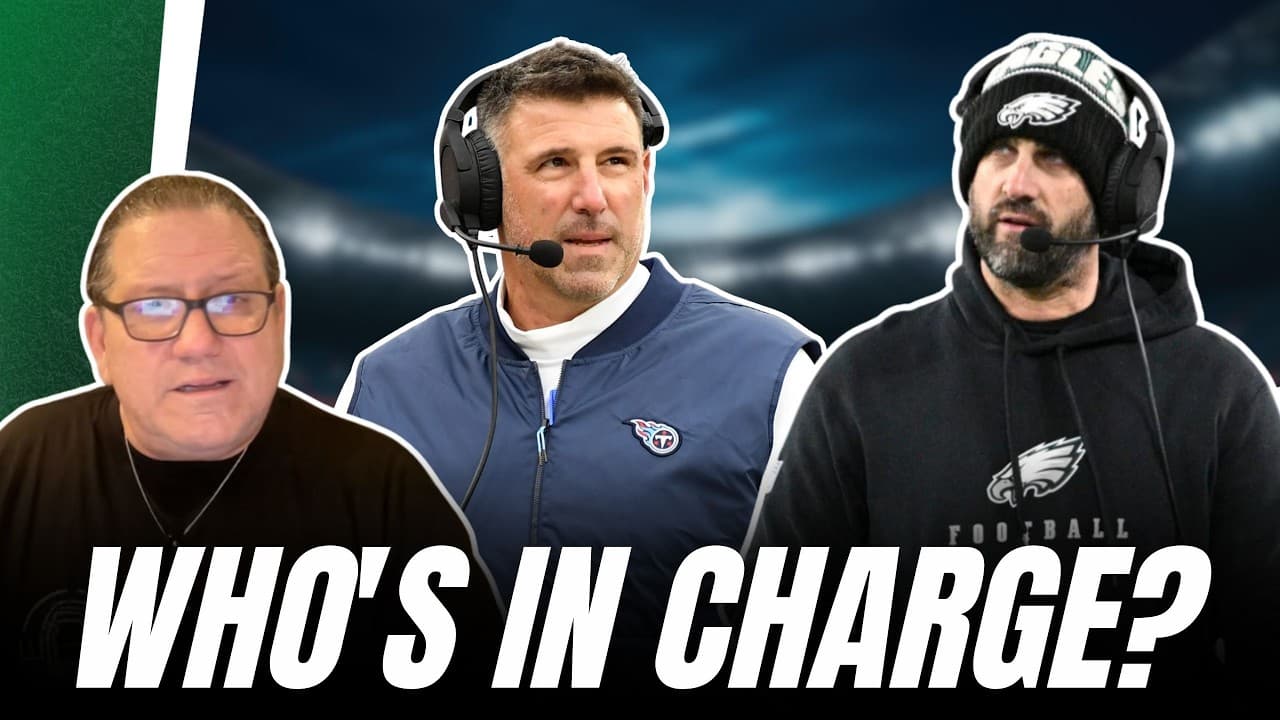
Mike Vrabel's blunt public assessment of his roster was more than a memorable press-conference answer. It illustrated how much a coach's authority shapes the way an organization communicates, and it raised a fair question about the Philadelphia Eagles: how freely can Nick Sirianni evaluate the roster built around him?
The issue is not whether every coach should criticize players or executives in public. Most should choose those moments carefully. The revealing part is whether a head coach appears empowered to name a weakness without creating an internal political problem.
Mike Vrabel can speak from a position of authority
Vrabel's directness works because his football operation appears tied closely to his judgment. When he identifies a depth problem, the message reaches players, personnel staff and fans at the same time. Everyone understands the standard and the area that requires improvement.
That approach carries risk. Public criticism can become empty theater if it is constant, vague or disconnected from personnel decisions. Used selectively, however, it creates clarity. A coach who controls the football direction can acknowledge that a position group is not good enough and then help determine the response.
The value is not toughness for its own sake. It is alignment between evaluation and authority. If the coach is accountable for Sunday results, his voice should matter when the roster's weak spots are discussed and addressed.
The Eagles operate through a different power structure
Philadelphia's structure places enormous value on front-office continuity, collaboration and message discipline. Howie Roseman builds the roster, manages the long view and protects organizational flexibility. Sirianni coaches inside that established framework.
That arrangement has produced stability, but it can blur where the final football judgment lives. Sirianni regularly supports his players and keeps internal disagreement out of public view. Those habits can protect a locker room. They can also make every personnel answer sound equally optimistic, even when the roster contains obvious uncertainty.
Fans do not need a coach to embarrass a young player or attack the general manager. They do need an honest explanation of what the team is trying to solve. There is a wide gap between reckless criticism and language so controlled that it communicates nothing.
The contrast becomes especially important when a new player or an unsettled position receives heavy praise before producing meaningful evidence. Positive reinforcement belongs in coaching. Public evaluation should still distinguish potential from proven performance.
Clear authority improves accountability
Every NFL organization divides responsibility differently. The problem begins when authority and accountability separate. If Sirianni is judged for the offense, player development and game-day decisions, he needs enough influence to confront weaknesses before they become losses. If the front office owns those decisions, that responsibility should also remain visible.
Vrabel's honesty resonates because it removes ambiguity. The roster has a problem, the coach sees it, and the organization knows it has work to do. Philadelphia often communicates through layers: the roster is praised, development is emphasized and the real concern remains behind closed doors.
That style can function while the Eagles are winning. It becomes harder to defend when the same position issue survives multiple weeks or when a highly promoted player is not ready for a meaningful role. At that point, controlled messaging begins to look like avoidance. Honest internal evaluation should still leave a visible trail of action.
The Eagles do not need Sirianni to imitate Vrabel's personality. They need the practical benefit behind it: a head coach able to state a football truth, connect it to a standard and help force a solution. The next roster weakness will show whether Philadelphia's hierarchy gives him that room or asks him to protect the message first.
Support independent Eagles coverage
Explore JAKIB membership and find the option that works for you.
The JAKIB Staff
AI-powered content assistant for JAKIB Sports. Articles generated from show transcripts and Eagles coverage.
Related Articles
Dallas’ Third-and-Long Failures Give the Eagles a Specific Opening
Dallas’ cushion and communication problems give Philadelphia a defined matchup to test. McKee still needs protection, clear routes and timely throws to make that opening count.
Chicago’s Quarterback Decision Tests Ben Johnson’s System Fit
Chicago’s quarterback debate turns on how Ben Johnson’s offense functions, not simply who has more talent. Caleb Williams’ questionable designation also keeps availability separate from the argument for Case Keenum.
Why Mike North Changed His Mind About Caleb Williams
Caleb Williams changed the argument by pairing explosive quarterback play with a Bears offense that produced two 100-yard rushers and 59 points. Ben Johnson's structure looks repeatable, but Chicago's defense still prevents one opener from becoming a complete verdict.
Why A.J. Brown's Eagles Exit Still Feels Unfinished
A.J. Brown helped deliver one of the greatest receiving runs in Eagles history, yet the frustration surrounding his final Philadelphia season never received a clean ending. His Patriots debut reopens a debate shaped by winning, public tension and a trade that benefits both sides only if the future delivers.
What Christian Parker's Exit Changes for the Eagles Secondary
Christian Parker's move to Dallas removes an important teacher from Philadelphia's secondary, but the Eagles retained Vic Fangio's structure and promoted experienced internal coaches. Quinyon Mitchell, Cooper DeJean and Riq Woolen now have to turn that continuity into consistent coverage.
Mike Golic Explains Why Jalen Hurts Is Elite for the Eagles
Jalen Hurts does not need 4,500 passing yards to deliver elite quarterback value for Philadelphia. Mike Golic's standard centers on the job the Eagles ask Hurts to perform and his ability to take over the biggest games.
Latest from JAKIB Sports
View all articles →Jeffrey Lurie’s Honor Arrives Amid an Eagles Trust Problem
October 26, 2026
The Eagles’ Film Meeting Changes the Room, Not the Personnel
October 26, 2026
DeVonta Smith’s Rest Question Is About Weeks, Not the Season
October 26, 2026
Caleb Williams and Ben Johnson Have Given Chicago a Window to Act
October 24, 2026