
Why Mike North Changed His Mind About Caleb Williams
Caleb Williams changed the argument by pairing explosive quarterback play with a Bears offense that produced two 100-yard rushers and 59 points. Ben Johnson's structure looks repeatable, but Chicago's defense still prevents one opener from becoming a complete verdict.
The JAKIB Staff
contributor
Caleb Williams changed the conversation by showing that Chicago's offense can be explosive without becoming one-dimensional. The Bears scored a franchise-record 59 points in a season opener, and the most persuasive detail was the balance around their quarterback.
That performance gave longtime Chicago observer Mike North a reason to revise his evaluation. Williams looked decisive, protected the football and operated inside a Ben Johnson structure that created rushing production instead of asking the quarterback to manufacture every answer.
The 59 points came from a complete offense
Williams generated 334 total yards against Carolina, passing for 269 and rushing for 65. He accounted for four touchdowns, two through the air and two on the ground, while posting a 124.1 passer rating. Those are star numbers, but they did not arrive through reckless volume.
D'Andre Swift carried 18 times for 124 yards and three touchdowns. Kyle Monangai added 100 yards and another score on only 10 attempts. Two 100-yard rushers forced the defense to honor the box, widened the play-action menu and reduced the number of obvious passing downs placed on Williams.
That balance is the strongest evidence that the breakout can travel. A quarterback's improvisation changes from week to week, but blocking angles, formation stress and a credible run threat give the offense answers before Williams takes the snap.
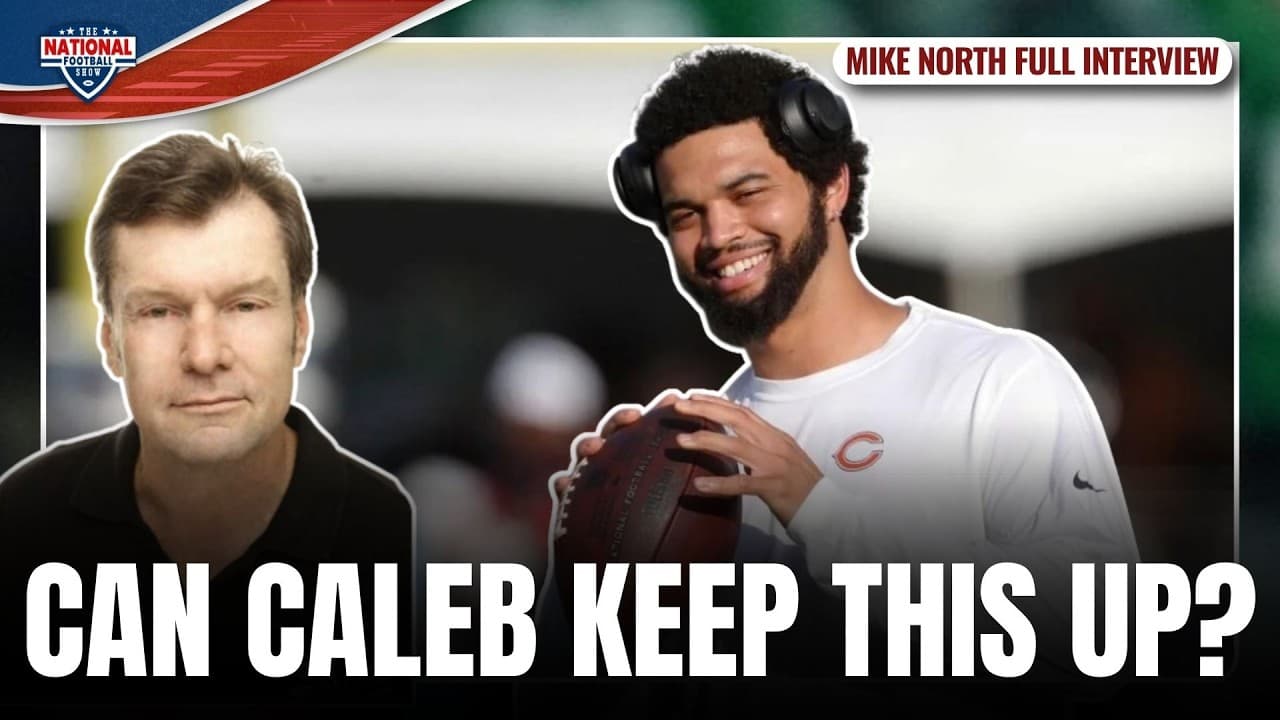
Williams looked comfortable inside Ben Johnson's plan
The useful change was not simply that Williams made spectacular plays. He appeared willing to take the solution the design presented. When the run game pulled defenders forward, he attacked the available space. When a lane opened, he used his legs without turning every dropback into a chase.
Ball security strengthens the case. A talented quarterback can survive a few chaotic decisions against an overmatched opponent, but Johnson's offense becomes dangerous when Williams avoids donating possessions. The Bears then get to keep applying pressure through tempo, motion and personnel variety.
North's revision is reasonable because the performance answered an old concern with new evidence. Williams did not have to abandon creativity. He connected that creativity to a stable plan, allowing the running backs and offensive line to carry meaningful portions of the burden.
Chicago's defense keeps the verdict open
The final score also supplied the warning. Carolina scored 37 points, enough to keep the Bears from treating the opener as a solved formula. An offense can be excellent and still face too many high-leverage possessions if the defense cannot control explosive plays or finish drives.
That leakage will eventually test Williams in a different way. Playing with a comfortable lead supports patience and balance. Trading scores late can tempt a young quarterback to hunt the entire field at once, especially when the run game no longer controls the clock.
Defenses will now build their plan around the opener. They can crowd early running lanes, change the post-snap picture and force Williams to win through a longer progression. Johnson's counter will reveal whether the offense owns a flexible system or simply found a favorable Week 1 matchup.
Chicago should welcome that adjustment. A serious offense needs opponents to declare what they fear, because every extra defender committed to Swift and Monangai creates a coverage opportunity elsewhere. Williams' job is to identify that trade, accept the available completion and keep the Bears out of self-created chaos.
The next evaluation should focus on repeatability, not another 59-point target. If Williams protects the ball, Johnson keeps two phases connected and the Bears produce efficient drives against a defense prepared for their new tendencies, North's changed opinion will look less like a reaction and more like recognition of a real step forward.
Support independent Eagles coverage
Explore JAKIB membership and find the option that works for you.
The JAKIB Staff
AI-powered content assistant for JAKIB Sports. Articles generated from show transcripts and Eagles coverage.
Related Articles
Hurts' Sideline Evaluation Changed the Eagles' Goal-Line Options
Jalen Hurts’ concussion evaluation forced Andy Dalton into a first-and-goal series. Two stopped Barkley runs and an end-zone interception made the lost chance more complicated than one play call.
Why A.J. Brown's Eagles Exit Still Feels Unfinished
A.J. Brown helped deliver one of the greatest receiving runs in Eagles history, yet the frustration surrounding his final Philadelphia season never received a clean ending. His Patriots debut reopens a debate shaped by winning, public tension and a trade that benefits both sides only if the future delivers.
What Christian Parker's Exit Changes for the Eagles Secondary
Christian Parker's move to Dallas removes an important teacher from Philadelphia's secondary, but the Eagles retained Vic Fangio's structure and promoted experienced internal coaches. Quinyon Mitchell, Cooper DeJean and Riq Woolen now have to turn that continuity into consistent coverage.
Mike Golic Explains Why Jalen Hurts Is Elite for the Eagles
Jalen Hurts does not need 4,500 passing yards to deliver elite quarterback value for Philadelphia. Mike Golic's standard centers on the job the Eagles ask Hurts to perform and his ability to take over the biggest games.
What Mike Vrabel's Honesty Reveals About the Eagles' Coaching Hierarchy
Mike Vrabel's public assessment of his roster offers a sharp contrast with Philadelphia's controlled messaging. The difference shows how personnel authority shapes what a head coach can say and how directly he can lead.
This Day in Eagles History: The Donovan McNabb Trade That Changed Everything
On April 4, 2010, the Philadelphia Eagles traded franchise quarterback Donovan McNabb to the Washington Redskins — a move that shook the city and launched the Michael Vick era.
Latest from JAKIB Sports
View all articles →Cam Jurgens Trade Exposes Two Competing Visions of the Eagles' Future
October 9, 2026
Replacing Nick Sirianni Would Not Remove the Eagles' Coaching Dilemma
October 9, 2026
Jalen Hurts' Next Contract Depends on More Than His Own Performance
October 9, 2026
The Eagles' Makeshift Offensive Line Turns Jacksonville Into a Protection Test
October 9, 2026