
Dallas’ Third-and-Long Failures Give the Eagles a Specific Opening
Dallas’ cushion and communication problems give Philadelphia a defined matchup to test. McKee still needs protection, clear routes and timely throws to make that opening count.
The JAKIB Staff
contributor
Dallas’ trouble finishing third-and-long gives Tanner McKee and the Eagles a specific opportunity: keep a difficult possession alive by identifying space near the first-down marker. It does not turn a favorable matchup into a guaranteed offensive revival.
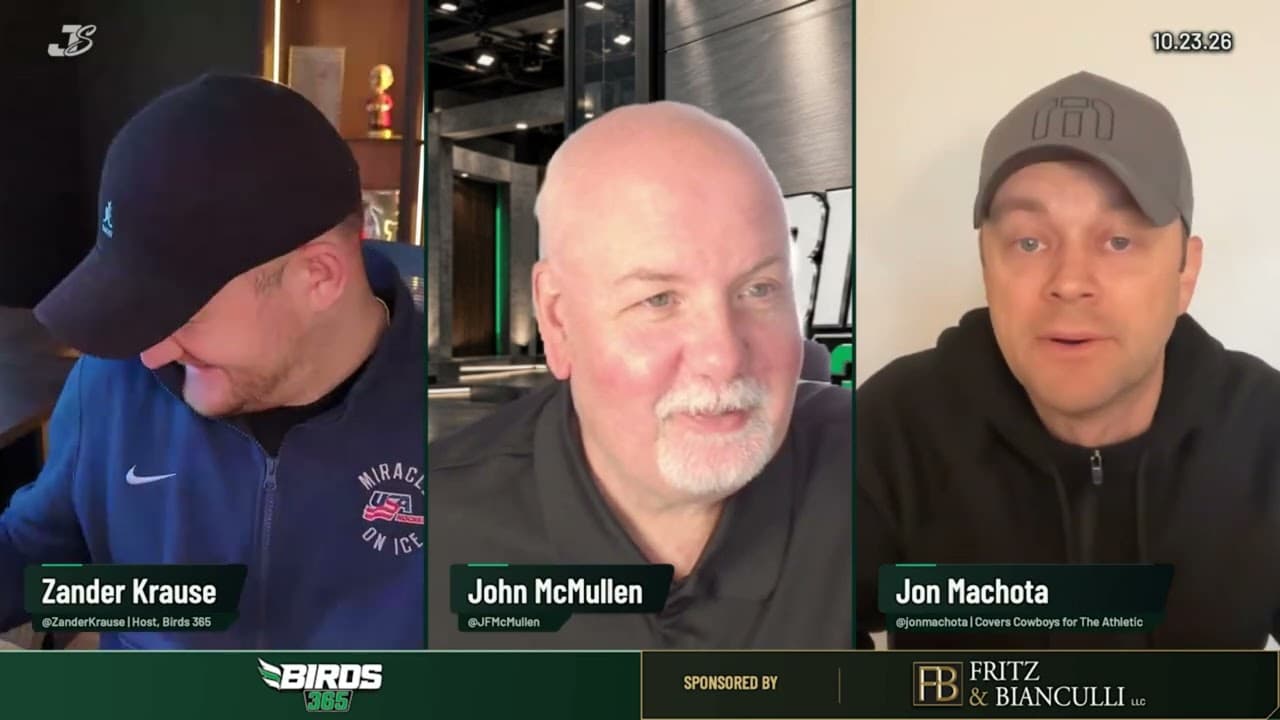
The opening described by Cowboys reporter Jon Machota on Birds 365 was unusually basic. Dallas has allowed too much cushion and struggled with communication in situations when the defense should have a clear advantage. His concern reached beyond ordinary third-and-long to distances that should make an offense uncomfortable.
For Philadelphia, the useful response is preparation. Know where the sticks are, understand the coverage and give the quarterback a route he can throw on time. The Cowboys’ problems create something to test. The Eagles still have to execute the test.
Make the cushion matter
Machota’s description focused on receivers finding room near the line to gain. His examples involved prominent targets, which makes the issue more troubling than a defense occasionally losing track of a secondary option.
Machota’s assessment identifies a matchup to test without establishing which defender was responsible for each breakdown.
The football consequence is clear enough. A defense protecting against the deep ball can still surrender the possession if it gives a receiver an uncontested throw at the sticks. Depth only helps if defenders understand what they are protecting and arrive in time to contest the catch.
Philadelphia should make Dallas demonstrate that coordination. A route breaking near the marker can ask whether the defender closes promptly. A receiver crossing a coverage boundary can test whether responsibility transfers cleanly. The spacing matters: crowding several routes into the same area can let one defender close on more than one option. Separating those routes can give McKee a clearer view of the available window.
The quarterback has a part in that, too. A completion underneath is valuable when the receiver has a realistic path to the necessary yardage. It is much less useful when the defense can concede the catch and make an immediate tackle.
McKee’s decision should follow the space Dallas actually presents. A vulnerable defense is still capable of baiting a throw or closing a window.
Give McKee an answer he can use
The Eagles’ Thursday report on McKee’s preparation described a full practice week ahead of his second start. That gives the preparation a concrete focus: turn the matchup discussion into throws the offense has rehearsed.
The best answer is not necessarily the longest route. On a difficult down, the quarterback needs protection, a clear progression and receivers who understand where their routes become useful. Every extra moment waiting for separation gives the rush another chance.
That is why the opening cannot become an excuse for Philadelphia to accept poor early downs. Third-and-long remains a situation to avoid. A game plan built around repeatedly escaping it would put unnecessary pressure on the quarterback and the protection.
The stronger approach is to stay on schedule, then have a credible response when a penalty, failed run or incomplete pass creates a longer distance. Dallas’ recent problems make that response worth emphasizing in preparation.
There is also a discipline test here. McKee does not need to chase a spectacular throw simply because the opponent has struggled. Recognizing an available first down and delivering an accurate ball would be a useful result on its own.
Dallas gets a chance to adjust
Christian Parker and his staff have the same evidence available to them. The Cowboys can change their leverage, tighten their spacing or simplify communication. Philadelphia should expect an attempted correction rather than assume the same opening will appear untouched.
The Cowboys’ later update on Parker’s coaching location said he was likely to remain on the field while discussing Mike Pettine’s arrival. The practical question for Philadelphia is how that staff helps Dallas coordinate its response, particularly when receivers threaten different levels of the coverage.
Monday night’s test comes on the field. Does Dallas crowd the marker? Does that create space elsewhere? Can Philadelphia recognize the adjustment before wasting a possession on the original expectation?
A defense with communication problems invites an offense to ask questions. It still takes coordinated routes, sound protection and an accurate throw to make the answers count. Watch the first difficult third down: where Dallas places its defenders, where the Eagles send their receivers and whether McKee gets a usable window before the rush arrives.
Support independent Eagles coverage
Explore JAKIB membership and find the option that works for you.
The JAKIB Staff
AI-powered content assistant for JAKIB Sports. Articles generated from show transcripts and Eagles coverage.
Related Articles
The Eagles Still Need an Evaluation Window for Keyshawn James-Newby
Keyshawn James-Newby has already played NFL snaps. With Arnold Ebiketie staying after a called-off trade, the Eagles still have a developmental rotation choice.
Dallas’ Coaching Problem Runs Deeper Than Replacing Brian Schottenheimer
Dallas won despite 14 accepted penalties for 153 yards against Indianapolis. Schottenheimer’s next test is whether reviewing those mistakes helps the Cowboys preserve the next advantage they create.
Dallas Goedert’s Staying Should Still Leave Room to Evaluate Eli Stowers
The Eagles can preserve Dallas Goedert’s role while creating a defined evaluation opportunity for Eli Stowers. Start with depth tight-end assignments and judge what Stowers does with consistent, purposeful work.
Joe Milton's First Eagles Test Includes What Happens Before the Snap
The Eagles must decide what Joe Milton can read from a stationary formation, what motion adds and whether gathering that clue leaves the rest of the offense enough time to execute.
The Eagles Trade Deadline Is About Value, Not a Roster Fire Sale
The Eagles can move veterans without dismantling their next roster. Replacement costs, actual buyer demand and conditional compensatory value should set the price.
The Cowboys’ Reset Problem Goes Beyond Another Coaching Change
Dallas needs its roster, coaching authority and offensive deployment to fit together. Another coaching change would need a coherent plan around it.