
The Eagles' Offensive-Line Reset Changes Jalen Hurts' Leverage
Philadelphia's changing offensive line affects the football support around Jalen Hurts. Contract and agent-shopping scenarios remain analysis, not evidence of a trade request.
The JAKIB Staff
contributor
Jalen Hurts' relationship with the Eagles cannot be evaluated separately from the offensive line around him. A roster reset changes the football support a quarterback receives and the questions that can shape future contract discussions.
The Eagles' official transaction ledger documents the October 7 agreement to trade Cam Jurgens to Baltimore. It also lists Landon Dickerson's September 15 placement on injured reserve. Those are verified changes to the offensive environment, not proof that Hurts or his representatives have requested a move.
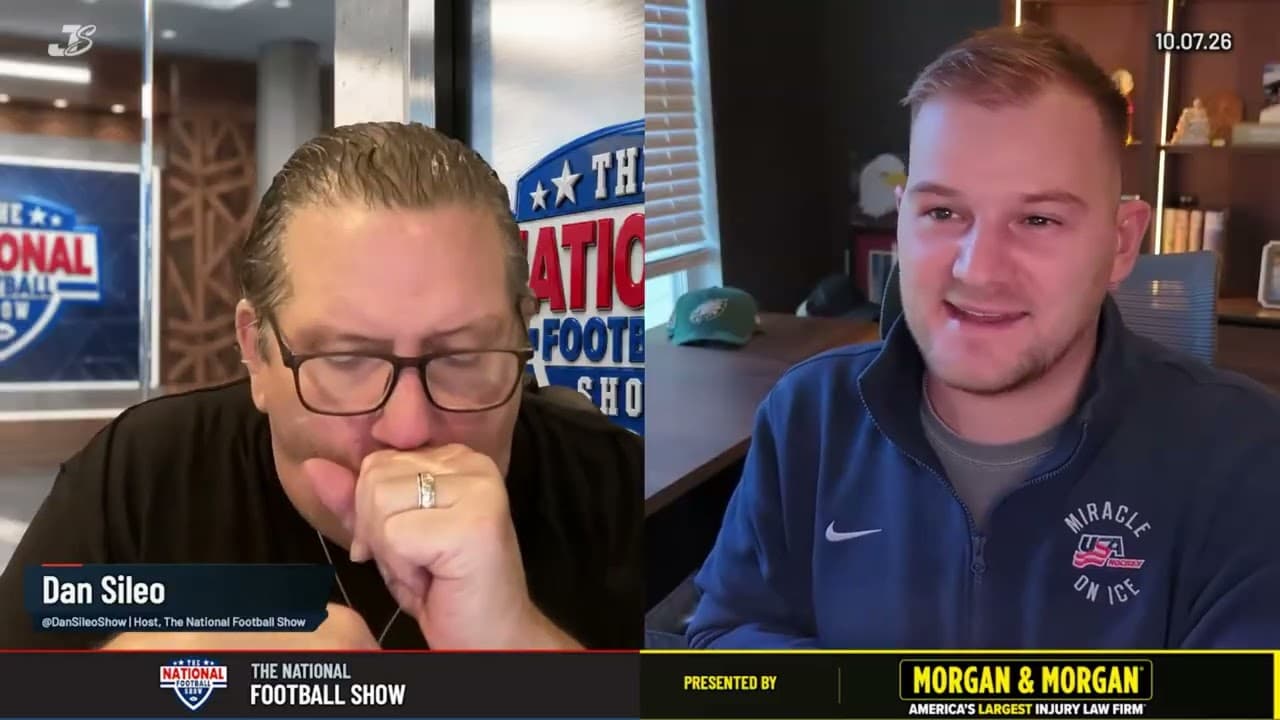
The National Football Show explored what the changing roster could mean for quarterback leverage. That discussion is a negotiating scenario, not confirmed reporting of agent contacts, a trade request or a planned contract confrontation. Keeping those categories separate makes the analysis more useful.
Roster support is part of the business discussion
A quarterback's performance is evaluated through his decisions, accuracy and execution. The conditions surrounding those decisions matter too. If protection becomes less predictable, coaches may change the passing game's timing, the amount of help assigned to blockers and the routes available downfield.
That creates a shared responsibility rather than a blanket excuse. Hurts still has to make the right read when the offense provides a workable opportunity. Philadelphia still has to explain how its personnel decisions support an offense built around its quarterback.
Those obligations can coexist. Criticizing a missed throw does not establish that the roster plan is sound. Questioning that plan does not erase a quarterback's mistakes. Contract discussions become distorted when either side tries to turn those separate evaluations into one convenient verdict.
The business issue is whether the team and player see the same competitive timeline. A quarterback who expects a strong immediate supporting cast may view future draft resources differently from a front office weighing several seasons. That possibility deserves analysis without inventing a private conversation.
Consent and compensation are separate hurdles
The no-trade scenario discussed on the show highlights a general negotiating distinction. Where contractual trade consent applies, a player's willingness to accept a destination is separate from the compensation two teams would negotiate. Neither question answers the other.
A team may prefer a transaction that a player rejects. A player may prefer a destination that cannot offer an acceptable return. A prospective acquiring team may also have different views about a new contract. A workable hypothetical has to account for all those interests.
None of that establishes that a Hurts transaction is underway. This analysis does not independently document current agent shopping, a demand for a particular salary or an instruction to stop playing. Specific claims about those actions would require reporting beyond an on-air scenario.
The same caution applies to guaranteed money and cap figures. Those numbers can depend on timing, structure and the exact transaction being considered. Without a verified current calculation, attaching an impressive figure would add apparent certainty rather than useful information.
The Eagles also carry leverage and responsibility
Philadelphia controls its roster decisions and can choose to keep investing around Hurts. Future picks create options, but options are not a commitment to a particular quarterback plan. The organization has to translate those resources into a competitive offense.
Hurts' side, meanwhile, has an interest in how the surrounding team affects both performance and career opportunity. A representative can assess that environment without acting like a fan defending every personnel move. That is a normal business consideration, not proof of a rupture.
The strongest version of this debate asks what each party can credibly offer the other. Can the Eagles present a convincing protection and personnel plan? Can Hurts deliver consistent execution within it? Answering those questions is more productive than assigning a trade destination that nobody has confirmed.
The next evidence should come from the offense's adjustment and from independently verified reporting, if negotiations become public. Watch whether the line changes force Philadelphia to restrict its passing game and whether Hurts converts the opportunities that remain. Until a concrete business development is established, agent-shopping and contract-showdown scenarios belong in the analysis column, not the transaction ledger.
Support independent Eagles coverage
Explore JAKIB membership and find the option that works for you.
The JAKIB Staff
AI-powered content assistant for JAKIB Sports. Articles generated from show transcripts and Eagles coverage.
Related Articles
The Eagles’ Young Offensive Line Is an Evaluation, Not a Finished Rebuild
Giving Drew Kendall, Willie Lampkin and Markel Bell an opportunity does not make the Eagles’ offensive line a finished rebuild. Philadelphia is collecting evidence about its next starters while asking the current offense to remain competitive.
The Eagles’ Offensive-Line Reset Is About More Than Replacing Lane Johnson
Replacing Lane Johnson requires an immediate protection plan and a longer-term investment decision. The Eagles also have to account for the rest of the line, not isolate every problem at right tackle.
The Eagles’ Offensive Line Is More Than a One-Game Problem
The Eagles’ offensive line has a Rams-week problem that reaches beyond one ugly night. If Jalen Hurts cannot trust the interior of his pocket, Philadelphia loses both the time to attack downfield and the freedom to make its run and pass concepts resemble one another.
The Eagles’ Zone-Run Transition Has an Offensive-Line Cost
The Eagles' zone-run transition is putting a different demand on an offensive line built with other blocking strengths. That helps explain why early-down runs can stall even when the ball carrier makes a reasonable decision. A reach landmark missed by one lineman can close the intended lane before.
The Eagles’ Offensive Line Is Aging Faster Than Its Scheme Can Adjust
The Eagles’ offensive line is aging faster than a new scheme can solve its problems Chris Kuper can change technique, combinations and protection rules, but a coaching adjustment cannot instantly restore the continuity that once made Philadelphia’s front a weekly advantage.
Why the Eagles' Offensive Line Problems Are Bigger Than Chris Kuper's Scheme
Philadelphia changed its offensive-line leadership, but the same problems have now followed the unit across 20 games. Chris Kuper can adjust the scheme; he cannot make declining or misplaced players perform like the elite line their reputation promises.
Latest from JAKIB Sports
View all articles →Lane Johnson's Hall of Fame Case Is Strong, but First Ballot Is a Separate Question
October 8, 2026
Why the Cam Jurgens Trade Leaves the Eagles With Two Different Timelines
October 7, 2026
Why Markel Bell Should Not Be Judged Against Lane Johnson Immediately
October 7, 2026
Why Winning the NFC East Matters More to the Eagles Now
October 7, 2026