
Jeff Stoutland’s Absence Raises a Bigger Eagles Continuity Question
Jeff Stoutland’s departure puts the Eagles’ offensive-line continuity under scrutiny. The current staff’s task is to transfer knowledge and build reliable combinations without treating retirement and trade counterfactuals as facts.
The JAKIB Staff
contributor
Jeff Stoutland’s absence leaves the Eagles with a continuity problem that extends beyond one coach’s reputation. Philadelphia is asking an altered offensive line to learn, communicate and recover from mistakes while the people and teaching structure around it are changing.
Stoutland left after 13 seasons, a departure announced in February. Chris Kuper now coaches the line alongside new offensive coordinator Sean Mannion. The Eagles’ introduction to Kuper’s approach described a transition in both instruction and blocking scheme.
That creates a useful question for the current staff: which parts of the old foundation remain valuable, and how quickly can replacements execute what the new offense asks? Nostalgia alone cannot answer either question. Neither can insisting that a new system will work once everybody gets comfortable.
Separate the roster facts from the Stoutland hypothetical
Lane Johnson retired on October 6. The following day, the Eagles announced an agreement to send Cam Jurgens to Baltimore for draft compensation, including a 2028 second-round pick. Those changes deserve scrutiny because they remove established experience from the line.
They do not prove that Stoutland could have prevented either decision. Johnson’s retirement was his own decision. A coach’s relationship with a player cannot establish what that player would have chosen under different circumstances. Jurgens’ trade was an organizational roster move with its own evaluation and return.
The stronger argument concerns what continuity provides while those decisions are being made. An established coach knows how a player receives corrections, which techniques hold up under pressure and how teammates communicate when a defense changes its presentation. Replacing that knowledge requires more than introducing a new voice.
It also requires restraint in assigning blame. A line can struggle because of availability, individual execution, the fit of a call or a communication failure. Treating every breakdown as proof that a departed coach was irreplaceable gives the current staff no specific problem to solve.
The line and the playbook have to meet in the middle
Blocking systems ask linemen to coordinate movement with the runner and one another. A familiar run concept can become less familiar when the timing, aiming points or combination rules change. An inexperienced replacement has to learn those relationships while also handling the opponent across from him.
That does not make change inherently wrong. A new approach can create useful answers and expand what an offense threatens. The responsibility is to determine which parts are ready for Sundays and which parts still need practice repetitions before becoming dependable calls.
The same principle applies in pass protection. The quarterback, center and other blockers need compatible answers to pressure. A receiver’s route cannot solve a protection problem if the ball is supposed to arrive before that route becomes available. Every part of the call has to share the same clock.
Philadelphia should therefore judge its new structure by specific evidence. Are repeated pressures producing the same confusion? Do corrections carry from one possession to the next? Can the line execute a small group of calls well enough that the offense can build from them?
Those questions produce better coaching answers than a weekly argument about whether the old staff would have won the game.
Make experience transferable before the next change
Veterans help a line through corrections that never become highlight clips. A quick conversation can settle an assignment or explain a defender’s tendency. When experienced players leave, the organization loses some of that informal teaching along with the player’s snaps.
The current coaches can respond by making that knowledge easier to share. Clear terminology, consistent corrections and practice situations that resemble the opponent’s pressures give less experienced players something concrete to repeat. Reducing uncertainty is a coaching task even when the available talent changes.
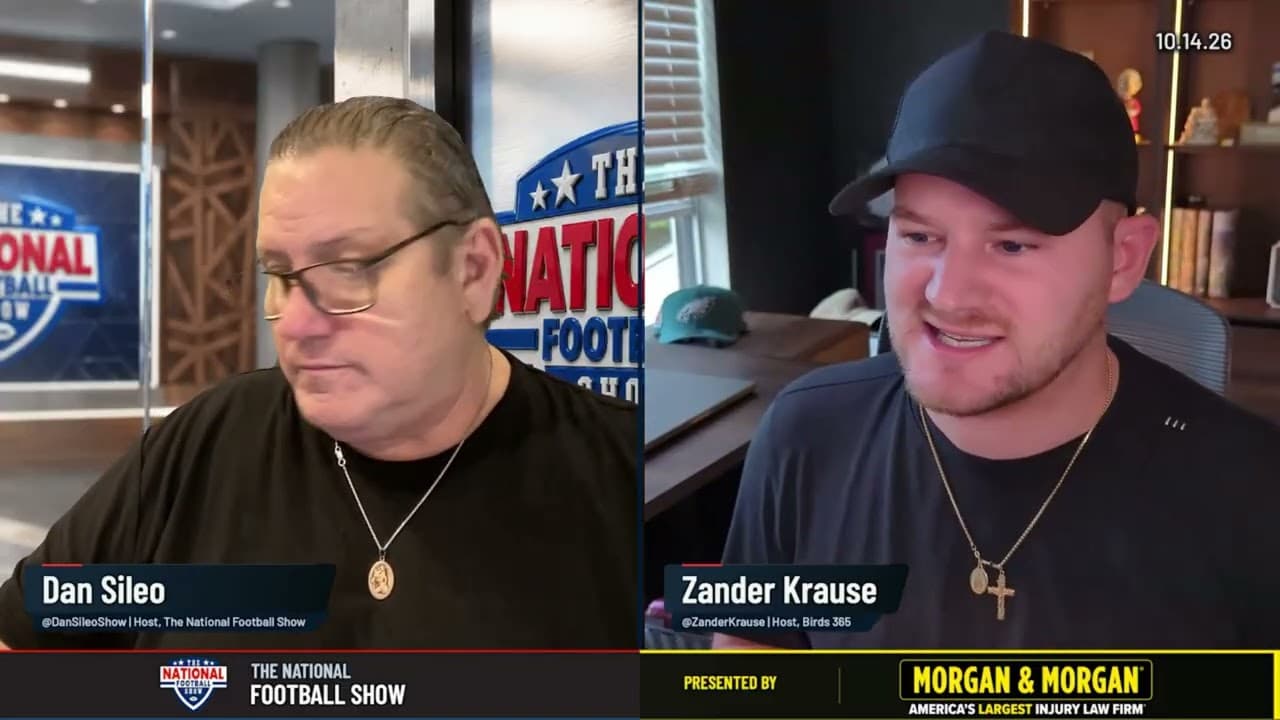
The National Football Show’s continuity discussion is most useful through that lens. Relationships matter because they can support communication and development. They are not evidence that a different coach could control a retirement or veto a trade.
For the Eagles, the next test is practical. Identify the combinations available, teach the calls they can execute and show that a mistake corrected early in the game stays corrected later. That is how a new staff begins creating its own continuity.
Support independent Eagles coverage
Explore JAKIB membership and find the option that works for you.
The JAKIB Staff
AI-powered content assistant for JAKIB Sports. Articles generated from show transcripts and Eagles coverage.
Related Articles
Jalen Carter Still Has Not Reached Jeffrey Simmons' Every-Down Standard
Jalen Carter can still produce dominant flashes, but Philadelphia needs him to control complete drives rather than isolated snaps. Jeffrey Simmons supplied the comparison: elite interior play travels through every down and every game situation.
Why the Eagles' Offensive Line Problems Are Bigger Than Chris Kuper's Scheme
Philadelphia changed its offensive-line leadership, but the same problems have now followed the unit across 20 games. Chris Kuper can adjust the scheme; he cannot make declining or misplaced players perform like the elite line their reputation promises.
The Eagles Built Their Offensive Line for a Scheme They No Longer Run
Philadelphia spent years selecting linemen for Jeff Stoutland's system. The transition to Chris Kuper has left an expensive group trying to execute a different approach without a clean personnel fit.
Drew Kendall's Week 2 Performance Changes the Eagles' O-Line Outlook
Drew Kendall handled his first start of 2026 against a Tennessee front led by Jeffery Simmons. His communication and composure give the Eagles a credible developmental center while the line works through early injuries and uneven play.
Why Garry Cobb Says the Eagles Aren't Playing Championship Football
Philadelphia is 2-0, but neither line is controlling games and the current formula depends too heavily on Jalen Hurts and DeVonta Smith. Jeffrey Simmons' relentless disruption also showed the standard Jalen Carter has not yet sustained.
How the Eagles' Offensive-Line Contingency Failed
Philadelphia built an offensive-line plan that depended too heavily on health and familiar starters. Cam Jurgens' post-surgery movement and the lack of a stable interior fallback have turned every protection call into a stress test for Jalen Hurts.
Latest from JAKIB Sports
View all articles →The Late-Game Decisions Driving the Eagles-Cowboys Blame Game
October 15, 2026
Technique Gives Jeremiah Trotter Jr. a Case for More Eagles Snaps
October 15, 2026
The Eagles’ Second-Half Plan Is Shrinking Jalen Hurts’ Options
October 15, 2026
The Eagles Can Buy for the Future Without Going All-In at the Trade Deadline
October 14, 2026