
How the Eagles’ Second-Half Offense Fell Apart Against Chicago
The Eagles were down only three at halftime in Chicago before three short possessions killed their comeback chance. Their 27-7 loss exposed problems in protection, down-and-distance and second-half execution.
The JAKIB Staff
contributor
The Eagles reached halftime in Chicago down only 10-7, with the ball coming back to them. Then their offense produced three short possessions to open the second half, and the Bears turned a manageable game into a 27-7 defeat. The collapse was not one mysterious adjustment. Philadelphia lost the down-and-distance battle, failed to protect Jalen Hurts consistently, and gave its defense almost no help.
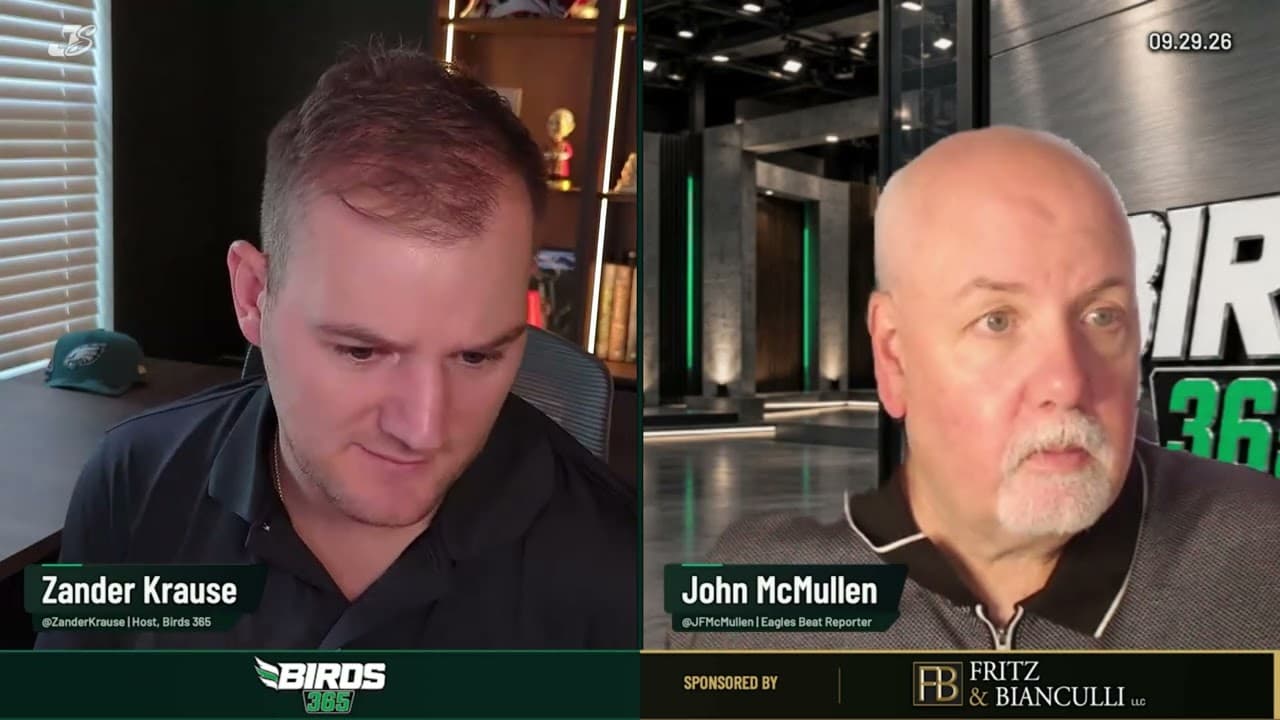
The official game recap records consecutive three-and-outs after halftime, followed by another punt. The Birds 365 breakdown asks how much belongs to the coaches and how much to the players. That distinction matters because a new play call cannot rescue a missed block or a hurried throw, while good execution cannot make a predictable or poorly matched call effective.
The halftime opportunity vanished fast
Hurts scored on a one-yard sneak at the end of the first half. That drive had a 30-yard catch by DeVonta Smith and a nine-yard completion to Zach Ertz. It gave Philadelphia a path back into the game despite an earlier end-zone interception during Hurts' brief absence. Receiving the second-half kickoff should have let the Eagles test whether that late-half movement could carry over.
Instead, they punted after three plays. They repeated the pattern on their next possession. Chicago had time to control field position, and a 41-yard Case Keenum touchdown pass to Kalif Raymond later pushed the lead to 20-7. Philadelphia's third possession of the quarter also ended in a punt after Hurts was sacked and a short completion to Will Shipley left fourth down. The offense never scored after halftime.
That sequence is more revealing than the final margin alone. A seven-point halftime deficit asks an offense for one sustained answer. Three quick exits force its defense back onto the field and narrow the playbook as the clock turns against it. Philadelphia did not simply lose a fourth-quarter shootout; it failed to establish a useful second-half rhythm while the game was still within reach.
Blocking and decisions share the burden
The line showed that it could create running room early. The Eagles' own review credited Saquon Barkley with 73 of his 82 rushing yards in the first half. That makes the later stalls harder to wave away as a game-long inability to move Chicago. The relevant question is why the useful early run looks and the late-half passing drive did not become a sustainable post-halftime plan.
The answer requires separating evidence from diagnosis. A sack, an ineffective play and a three-and-out are observable. A specific unreported injury or private protection error is not. The full-game analysis and the second-half clip frame pressure and personnel as football problems, but neither gives license to invent an injury explanation. Coaches can change protection, personnel or launch points. Players still have to identify the front, finish blocks and make the throw the situation requires.
Third down is where those responsibilities meet. If a run or short pass creates a long-yardage problem, the defense can rush with less fear of the run. If protection then breaks down, the quarterback's menu shrinks. Simply asking for more aggressive calls ignores the cost of putting a struggling unit into obvious passing downs. Simply blaming the line ignores the offense's responsibility to avoid them.
The Rams game will test the repair
Philadelphia's next opponent is the Rams, and the Eagles' Tuesday review notes that the offense has not scored in the first quarter through three games. It also singles out third-quarter performance. Those are distinct problems, but they meet at the same point: the offense cannot keep relying on one late burst to erase a long stretch of stalled possessions.
The first measure of improvement is not a spectacular deep ball. It is whether early-down runs and quick answers keep Hurts out of repeated rescue situations after halftime. Philadelphia can distribute blame across play design and execution, but it cannot distribute the next test. Against Los Angeles, the first two second-half drives need to look like part of a coherent offense, not another reset after a promising finish to the first half.
Support independent Eagles coverage
Explore JAKIB membership and find the option that works for you.
The JAKIB Staff
AI-powered content assistant for JAKIB Sports. Articles generated from show transcripts and Eagles coverage.
Related Articles
Tanner McKee Won’t Get a Clean Test of the Eagles’ Offense
Tanner McKee will be evaluated alongside the Eagles’ protection, route timing and coaching adjustments. The Carolina game can reveal what works for the backup and what the whole offense still needs.
The Eagles’ Second-Half Plan Is Shrinking Jalen Hurts’ Options
The Eagles need a second-half approach that protects the ball without removing their best answers. Coaching design and Jalen Hurts’ decisions both shape whether a lead becomes another possession or another defensive burden.
Four Games Could Decide Howie Roseman's Trade-Deadline Approach
Four games could decide how Howie Roseman approaches the trade deadline. The Eagles' next stretch should clarify whether a valuable offer serves a realistic playoff push or a roster that needs a faster reset.
The Eagles' Second-Half Collapse Is More Than an Injury Problem
The Eagles' second-half collapse is more than an injury problem. Philadelphia's offense has to produce answers after its opening success, not just explain why the available personnel changed.
The Eagles’ Bigger Problem Beyond the Final Kickoff
The kickoff decision deserves scrutiny, but Philadelphia’s recurring offensive breakdown matters more. Hurts, the staff and the line all face a more durable test.
What the Eagles Would Need From a Nick Sirianni Successor
A hypothetical coaching change would test how much football authority the Eagles give their next leader. The issue is staff control and clear accountability, not a famous name.
Latest from JAKIB Sports
View all articles →The 2017 Eagles' Locker-Room Lesson for a Team Losing Its Leaders
October 19, 2026
Eagles' Defensive Stars Face a Different Test Than Their Backups
October 19, 2026
The Bad Snap That Closed the Eagles' Best Route Back Against Carolina
October 19, 2026
Chicago’s Quarterback Decision Tests Ben Johnson’s System Fit
October 17, 2026