
Joe Milton’s First Start Exposed an Offense That Needs to Get Simpler
Joe Milton’s first start put the Eagles’ protection and teaching under scrutiny. A simpler offense can give an inexperienced quarterback clearer answers without hiding the tradeoffs.
The JAKIB Staff
contributor
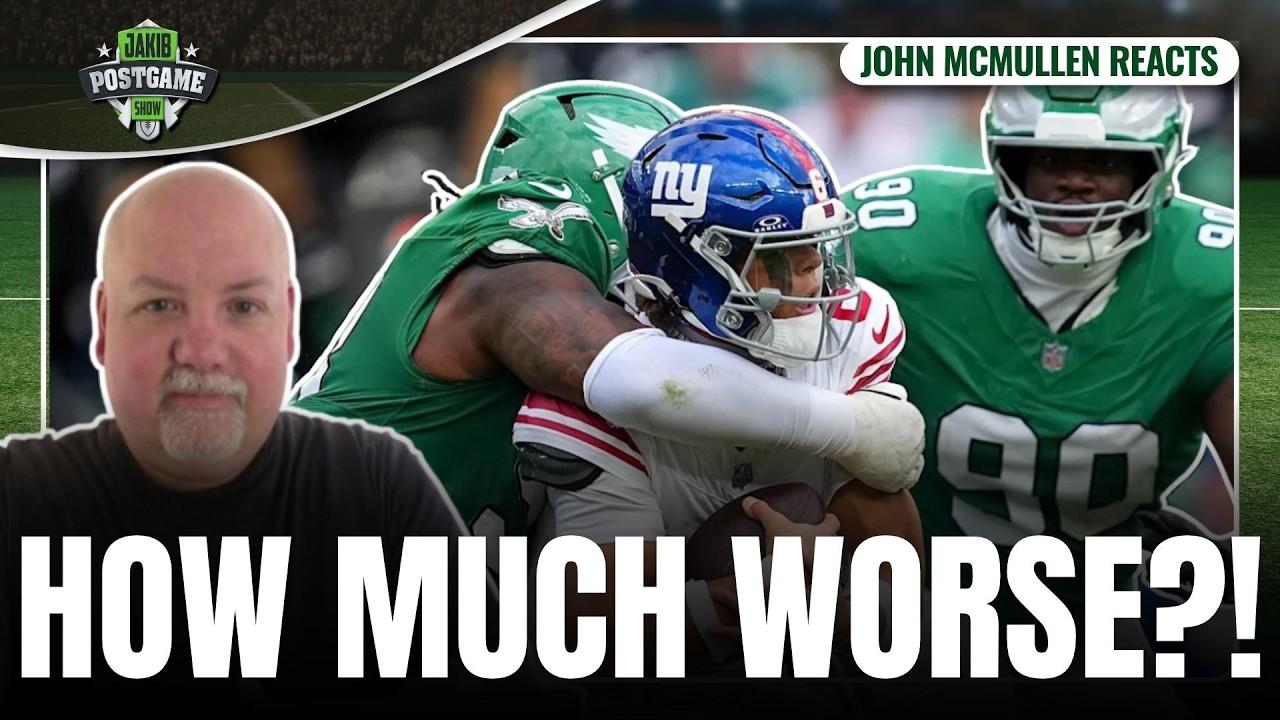
A defender can look like a pass rusher long enough to occupy a blocker, then disappear into coverage. Someone else comes free. For an inexperienced starting quarterback, that changing picture can wreck a play before the route has a chance to develop.
That is the protection problem at the center of the Eagles’ postgame discussion following their 19–11 loss to the Giants. Joe Milton made his first career start Sunday. The useful question now is how Philadelphia can give him clearer answers before the snap and fewer emergencies after it.
Changing quarterbacks does not automatically change the difficulty of those assignments. The offense has to change what it asks the quarterback, blockers and receivers to solve together.
When the rush picture changes
The embedded breakdown offers a specific interpretation of a Giants pressure: a defender engages the offensive line before dropping into coverage, drawing attention inside and helping create an unblocked path elsewhere. That is the panel’s explanation of the play, rather than a verified account of Philadelphia’s protection call.
The distinction matters. Without the assignment, identifying the free rusher does not establish which Eagle made the mistake. A tackle, running back and quarterback can all be involved in sorting the same threat. The visible result tells us the protection failed to account for the pressure. It does not reveal every instruction that preceded the snap.
The football challenge is easier to understand. A blocker has to react to a defender who appears committed to rushing. When that defender drops away, the offense must still handle the player who actually comes. A protection plan needs rules that survive the disguise, with a shared understanding of who handles each threat.
That is why teaching belongs in this discussion alongside individual execution. If the quarterback recognizes one picture and the line responds to another, physical ability alone will struggle to rescue the play.
Give the quarterback a smaller problem
Simplifying the offense should mean choosing a manageable set of answers and practicing them until everyone understands the same thing. It cannot mean merely telling Milton to get the ball out faster.
Keeping additional help in protection is one option raised in the discussion. The tradeoff is straightforward: players helping block are unavailable as immediate receiving options. But a smaller route combination can still offer a better chance than a larger one the quarterback has no time to read.
Clearer pressure responses should accompany that choice. The quarterback needs to know where the ball can go when the defense brings more rushers than the protection can handle. The receiver has to understand the same answer. Adding concepts has little value if that basic agreement remains uncertain.
The timing of Milton’s opportunity deserves the same scrutiny. The postgame discussion questioned using him before the Week 10 bye rather than allowing that preparation window first. That is a criticism of the decision, not proof of why the Eagles made it. Still, once the staff chose to start him, the game plan needed to reflect his first-start experience.
A scramble cannot explain the whole offense
Milton’s ability to escape can be useful without proving that the designed offense fits him. An improvised run and a successful called play answer different questions.
A scramble can salvage a possession after protection or timing breaks down. Building an offense requires repeatable answers: blocking that gives the play a chance, routes connected to the quarterback’s reads, and a response when the defense changes the picture. Escape ability provides another chance when those pieces fail. It should not become the plan for making them work.
That distinction also matters when evaluating the quarterback. A difficult play that he rescues should not erase the original breakdown. A failed play should not automatically become evidence that he missed an assignment the public cannot see.
Philadelphia’s next offensive plan should make the intended answers easier to recognize. Keep the protection rules consistent. Pair them with routes the quarterback can reach on time. Use extra help where the matchup demands it, and accept the limits that choice creates. Milton has enough to learn in his first opportunity to start; the coaching staff should give him a defined job he can execute and build from there.
Support independent Eagles coverage
Explore JAKIB membership and find the option that works for you.
The JAKIB Staff
AI-powered content assistant for JAKIB Sports. Articles generated from show transcripts and Eagles coverage.
Related Articles
Caleb Williams’ Improvement Starts With the Structure Around Him
Caleb Williams completed 70.9 percent of his passes across five starts through Week 8. Protection, run-game connections and continuity offer a framework for examining the improvement without taking credit away from the quarterback or treating a small sample as causal proof.
The Eagles’ Backup Quarterback Problem Is Bigger Than One Bad Start
The Eagles invested in backup quarterbacks. The harder question is whether practice work, scheme fit and a usable replacement plan prepared the offense to function when the quarterback changed.
Joe Milton's First Eagles Test Includes What Happens Before the Snap
The Eagles must decide what Joe Milton can read from a stationary formation, what motion adds and whether gathering that clue leaves the rest of the offense enough time to execute.
Nick Sirianni's 48-Hour Quarterback Reversal Creates a Credibility Problem
Sirianni backed Tanner McKee on Monday before the reported switch to Joe Milton on Wednesday. Explaining the football purpose now carries consequences for his next public commitment.
Joe Milton Adds Mobility. The Eagles Still Have to Solve the Play Clock.
Joe Milton gives the Eagles another way to create yards. A workable pre-snap operation will determine whether his athleticism supports the offense or keeps rescuing it.
Joe Milton Gives the Eagles a New Test, Not a Clean Slate
Joe Milton changes the Eagles’ options against the Giants. Protection, clear answers and adjustments after the opening script will determine whether the plan holds up.