
The Eagles' New Offense Must Adapt to Jalen Hurts
Philadelphia can borrow useful ideas from the Shanahan-McVay coaching tree, but the system must fit Jalen Hurts and Saquon Barkley. Pistol, option concepts and efficient early downs offer a better bridge than forcing a copycat offense.
The JAKIB Staff
contributor
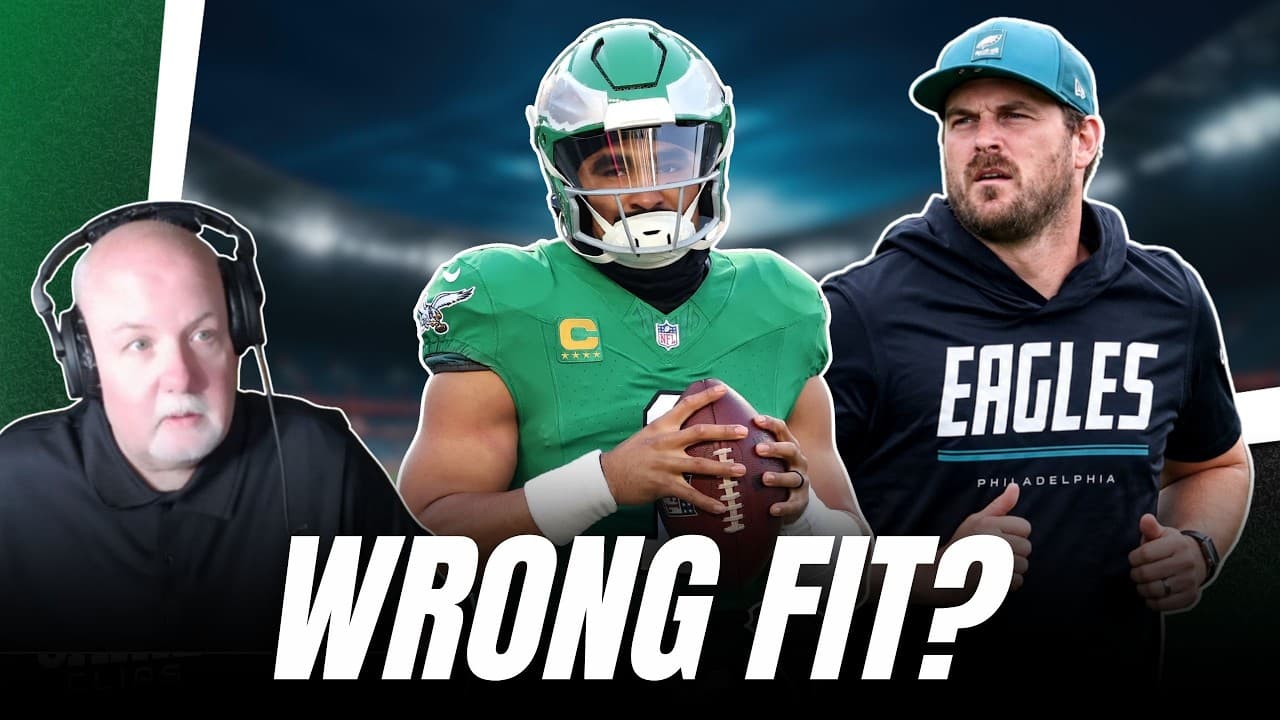
The Philadelphia Eagles cannot build their new offense by treating Jalen Hurts like a generic quarterback dropped into a fashionable system. Sean Mannion can borrow concepts from the Shanahan-McVay family, but the final product has to reflect the players in Philadelphia. If the structure helps Saquon Barkley while stripping away too much of what Hurts does best, the Eagles will have traded one problem for another.
This is not an argument against under-center runs, motion, play action or any other modern tool. It is an argument for adaptation. Good offenses do not win because their diagrams resemble the league's most popular diagrams. They win because the scheme creates favorable situations for the talent actually executing it.
Copying a system is only the starting point
The league constantly borrows from successful teams. Once an idea spreads, defenses spend an offseason building answers for it. That means Philadelphia cannot assume a familiar bootleg or under-center sequence will produce the same advantage it created for another team two years earlier. The Eagles need counters, variation and a clear understanding of how Hurts changes the geometry of a defense.
Hurts has spent most of his football life operating from the shotgun, reading defenders and using his legs as part of the play's structure. Asking him to work under center more often can be useful, particularly when it helps Barkley attack the line with momentum. Asking him to abandon the concepts that have made him dangerous would be a misuse of the quarterback.
The offense should be built as a blend. Philadelphia can create downhill opportunities for Barkley without removing the run-pass option and zone-read elements that force a backside defender to account for Hurts. Those threats are not gimmicks. They change the numbers in the box and can make the conventional run game more efficient.
Pistol can connect Hurts and Barkley
Pistol formations offer a logical middle ground because Hurts can remain off the line while Barkley aligns behind him. The back can still attack downhill, and the quarterback can retain options to either side. Philadelphia can use motion, play action and traditional runs from that look without making every snap feel foreign to Hurts.
That flexibility matters because Barkley should remain the offense's stabilizer. A productive running game can keep Philadelphia out of third-and-long, create simpler coverage pictures and give the passing game room to operate. If the Eagles consistently reach manageable downs, Mannion can call the entire playbook. If early downs fail, even the best-designed third-down menu becomes limited.
The passing game's improvement may therefore begin with Barkley, but it cannot end there. Hurts still needs answers that match his timing and vision. Receivers must win their routes. The offensive line must execute the protections and wide-zone movement. Scheme can create an opening, but players have to turn it into production.
Efficiency is the correct standard
Philadelphia does not need to chase an arbitrary passing-yard total to prove the new offense works. The better standard is efficiency: fewer negative plays, cleaner early downs, better red-zone execution and reliable answers when defenses take away the first option. Hurts does not need empty volume. He needs an offense that helps him make decisive plays while preserving the physical pressure he places on a defense.
That also means Mannion should resist becoming predictable. Bootlegs and flat routes can create easy completions early, but defenses adjust when the same sequence appears repeatedly. The Eagles need complementary calls that punish those adjustments. Every successful concept should set up the next one.
Build around the quarterback, not the trend
The Eagles have enough talent to make this blend work. Barkley can force defenses to honor the run. Hurts can punish undisciplined edges and create outside the original design. DeVonta Smith and Dallas Goedert can win in areas that keep the passing game on schedule. The coordinator's job is to make those strengths reinforce one another.
Philadelphia should study every successful offense in the league, but imitation cannot become identity. The test for Mannion is whether he turns borrowed concepts into an Eagles offense—one that makes life easier for Barkley without making Hurts less dangerous. If the scheme adapts to the quarterback, the new structure can expand the offense. If the quarterback is forced to adapt to the scheme alone, the fit will always remain the biggest concern.
Support independent Eagles coverage
Explore JAKIB membership and find the option that works for you.
The JAKIB Staff
AI-powered content assistant for JAKIB Sports. Articles generated from show transcripts and Eagles coverage.
Related Articles
Tanner McKee Won’t Get a Clean Test of the Eagles’ Offense
Tanner McKee will be evaluated alongside the Eagles’ protection, route timing and coaching adjustments. The Carolina game can reveal what works for the backup and what the whole offense still needs.
Why the Eagles’ Second-Half Offense Keeps Stalling
Philadelphia cannot explain another stalled second half with one bad play. The Eagles need a repeatable early-down plan and real counters when a defense adjusts.
Why the Eagles’ Second-Half Offense Remains Their Biggest Problem
The final kickoff decided the Jacksonville game, but Philadelphia’s 232-yard offense creates a more persistent test for Jalen Hurts and the play-calling staff.
What Lane Johnson’s Retirement Changes for the Eagles’ Offense
Lane Johnson’s retirement changes more than the name at right tackle. Philadelphia now has to redistribute protection responsibility without shrinking the entire passing game.
Why the Eagles’ Offense Still Has No Clear Identity
The Eagles have tried to blend new and familiar offensive concepts. The real test is whether Jalen Hurts and the line have connected answers when defenses change the picture.
The Eagles’ Second-Half Offense Needs More Than a Fast Start
The Eagles' second-half offense needs more than a fast start because an opening plan cannot carry an entire game. Philadelphia's next offensive improvement should be measured by what happens after the defense has seen its preferred calls and adjusted.
Latest from JAKIB Sports
View all articles →The 2017 Eagles' Locker-Room Lesson for a Team Losing Its Leaders
October 19, 2026
Eagles' Defensive Stars Face a Different Test Than Their Backups
October 19, 2026
The Bad Snap That Closed the Eagles' Best Route Back Against Carolina
October 19, 2026
Chicago’s Quarterback Decision Tests Ben Johnson’s System Fit
October 17, 2026