
Jake Majors’ Natural Position Matters in the Eagles’ Center Decision
Jake Majors’ natural position gives the Eagles a reason to limit disruption at center. Availability and exchange reliability should drive the decision without turning an unofficial depth chart into a starting lineup.
The JAKIB Staff
contributor
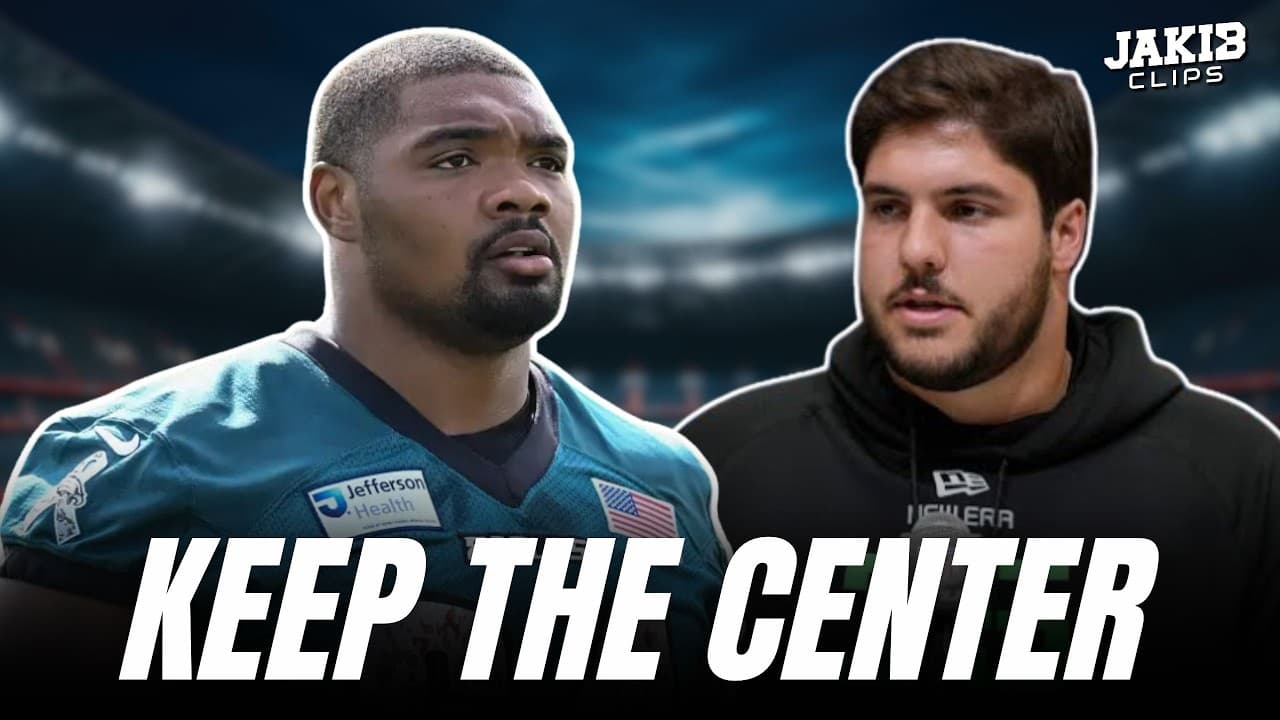
Jake Majors’ case at center begins with keeping the Eagles’ offensive line from changing more than necessary. With Tanner McKee preparing to start against Carolina, Philadelphia should give real weight to position continuity before solving one vacancy by creating another.
That is a recommendation about the available choices. The Eagles’ explicitly unofficial depth chart lists Drew Kendall and Majors at center and Willie Lampkin at left guard. It does not announce Sunday’s starting combination.
The Thursday injury report listed Kendall and Landon Dickerson as limited. Dickerson remained in his opened practice window. Those facts leave availability questions unresolved; they do not establish that either player will start against the Panthers.
Center continuity reaches the quarterback
A center decision affects every offensive play before any block can be graded. The exchange gives the quarterback possession and starts the timing for everyone else. A bad snap can disrupt a sound call before the defense has to defeat it.
The center discussion on Birds 365 identified Majors as the natural center option while raising concerns about his recent snapping. It also raised snapping concerns about Lampkin’s work at center in training camp. Those are issues presented in the source discussion, rather than independently charted error totals or proof that either player will struggle Sunday.
They do, however, expose the weakness in assuming that a position change automatically fixes the exchange. Replacing one uncertain option with another requires evidence about the replacement’s readiness. A different name at center does not supply that evidence by itself.
For McKee, consistency in the exchange is especially valuable during an abrupt starting assignment. He already has to prepare for Carolina’s defense and operate the offense. Adding a new center arrangement increases the number of relationships the staff has to establish within the same limited week.
Moving Lampkin carries a second decision
The appeal of a shuffle is understandable. If Dickerson becomes available at guard, moving Lampkin to center could appear to offer a straightforward way to rearrange the interior. But the proposal changes Lampkin’s assignment as well as the player beside him.
The better question is whether that full combination gives Philadelphia a stronger, more dependable line. Comparing individual players in isolation can miss the cost of moving responsibilities around. Every change creates another place where timing and communication need to hold up.
Keeping Majors at center would preserve a clearer division of work: evaluate the center at center, then settle left guard according to actual availability. That approach deserves preference unless the staff has a convincing football reason to change it.
Preference is not certainty. If practice evidence favors Lampkin, the Eagles can act on that evidence. The argument for continuity should establish a meaningful threshold for a move, rather than turn Majors’ natural position into an automatic entitlement to the job.
The same caution applies to Dickerson. His name offers an appealing answer because the discussion included his ability to play center. His current practice status still leaves a separate availability question. Combining those two ideas into a projected starting assignment would run ahead of what is established.
Choose the combination that can function together
The center’s job extends beyond the snap, but the exchange is a useful starting point for this decision. It forces the evaluation toward a repeatable task the entire offense depends on. Reputation and positional flexibility cannot make that task optional.
Protection communication belongs in the same evaluation. A line can have capable individual blockers and still create a problem if adjacent players interpret a responsibility differently. With McKee taking over, reducing avoidable confusion should carry more weight than finding the most attractive arrangement on paper.
There is also a difference between a player participating in practice and a complete unit being ready for Sunday. Limited participation supplies information about that day’s work. The final combination still depends on availability and the staff’s assessment of how those players function together.
Majors therefore deserves a serious chance to hold the center job while the Eagles resolve their guard options. That position follows the logic of limiting disruption; it does not require dismissing his snapping concerns or claiming the alternatives have been eliminated.
Watch the final availability decisions and the actual center-quarterback exchange when Philadelphia takes the field. Those will tell more about this choice than an unofficial chart or a hypothetical reshuffle. The first requirement is getting McKee a dependable start to the play.
Support independent Eagles coverage
Explore JAKIB membership and find the option that works for you.
The JAKIB Staff
AI-powered content assistant for JAKIB Sports. Articles generated from show transcripts and Eagles coverage.
Related Articles
The Late-Game Decisions Driving the Eagles-Cowboys Blame Game
The Eagles and Cowboys reached painful last-second losses through different breakdowns. Reviewing offensive timing, kickoffs and defensive instructions together offers a clearer answer than choosing a single scapegoat.
How the Eagles Lost the Final Eight Seconds Against Jacksonville
Philadelphia led Jacksonville with eight seconds left but lost on a final field goal. The clock, kickoff choice and coverage failure each deserve a separate review.
Why the Eagles’ Run and Pass Games Aren’t Working Together
The Eagles’ run and pass games aren’t working together when one fails to make the other easier. Against Jacksonville, 22 rushing yards left Jalen Hurts carrying a passing workload that produced too little sustained offense.
The Clock Decision That Preserved Jacksonville’s Winning Chance
The Eagles preserved Jacksonville’s winning chance when their final possession left eight seconds for a kickoff. The clock stopped on Makai Lemon’s late catch, allowing the Jaguars to save their last timeout for the next play.
Jalen Hurts’ C-Minus Game—and the Offensive Line Behind It
A C-minus is a defensible editorial grade for Jalen Hurts’ uneven afternoon against Jacksonville. But fixing the Eagles’ passing game requires examining the protection and rushing support behind him, not simply circling the quarterback’s name.
Why the Eagles Couldn’t Finish Off Jacksonville
The Eagles couldn’t finish off Jacksonville because their offense stopped giving the defense breathing room. A 19-17 loss turned another winnable afternoon into a reminder that late heroics cannot replace sustained scoring.
Latest from JAKIB Sports
View all articles →Chicago’s Quarterback Decision Tests Ben Johnson’s System Fit
October 17, 2026
Howie Roseman’s Roster Reset Still Needs Immediate Impact Players
October 17, 2026
Makai Lemon’s Next Opportunity Is About Where the Eagles Target Him
October 16, 2026
What Nick Sirianni’s Preparation Shows Beyond the Eagles’ Final Scores
October 16, 2026