
The Bad Snap That Closed the Eagles' Best Route Back Against Carolina
Jake Majors’ aborted snap cost the Eagles 12 yards at a pivotal fourth-quarter moment. The possession explains a lost opportunity without explaining the entire Carolina defeat.
The JAKIB Staff
contributor
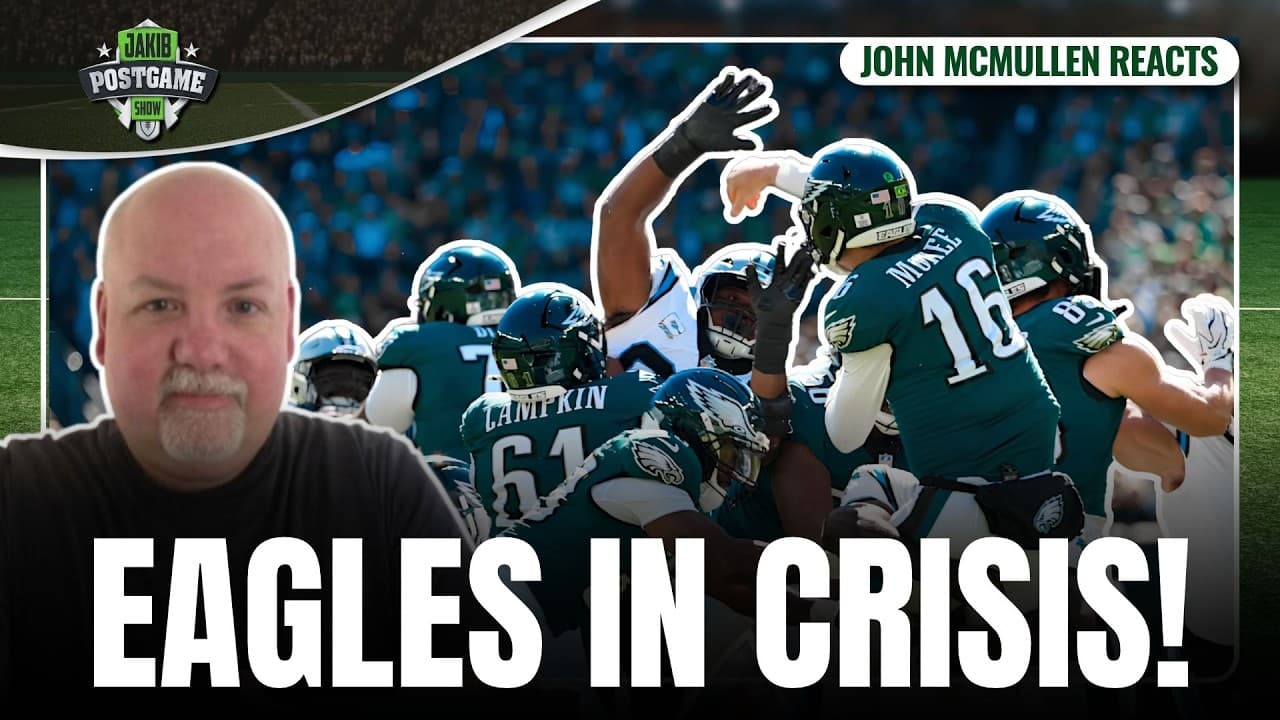
The Eagles had the ball near midfield, a five-point deficit and a chance to change the afternoon. Jake Majors' bad snap turned that opportunity into a recovery operation before Tanner McKee could run the play.
Philadelphia lost 25–14, but a touchdown from that position could have put the Eagles ahead. The snap changed first-and-10 into second-and-22 before Carolina had to defend the intended play. A pivotal fourth-quarter chance suddenly required an offense struggling to move the ball to make up ground it had just given away.
Starting near midfield gave Philadelphia a useful advantage. McKee's recovery kept the ball in Eagles hands, but the offense now needed a response to the mistake before it could get back to the business of taking the lead.
What the Eagles actually lost at midfield
The official NFL gamebook puts the play at 9:32 of the fourth quarter, with Philadelphia trailing 19–14 at its own 48. McKee covered the aborted snap at the Eagles' 36. A four-yard completion followed, then an incompletion and a punt. Philadelphia kept possession through the mistake but never recovered enough ground to sustain the drive.
A touchdown could have changed which team was chasing the game. From the Philadelphia 48, the Eagles had 52 yards to the end zone. After the snap, they were 64 yards away and already facing second down. Those are concrete costs for an offense that had not shown it could make long gains routine.
The four-yard completion illustrates the problem. That gain left third-and-18. Moving forward was no longer enough to keep the series manageable; Philadelphia needed a substantial play simply to extend the possession.
Long yardage also gives the defense room to concede a modest gain while protecting the line to gain. The offense has to recover ground with a bigger play or use its remaining downs to work back toward the chains. Philadelphia never returned to a manageable situation before the punt.
Recovering the ball was important. The next requirement was to recover the drive. The Eagles failed to do that, and a possession that began close to midfield ended with the offense still in its own territory.
The snap belongs in the larger offensive picture
Philadelphia finished with 222 total yards and 35 rushing yards, according to the gamebook. Those numbers help explain why a 12-yard setback carried so much weight. This was an offense that had already struggled to create enough productive movement across an entire game.
The bad snap was particularly costly in that setting. A unit consistently generating first downs can absorb a negative play more readily. An offense struggling to sustain anything cannot treat a favorable starting position as replaceable.
That is also why blaming the afternoon on Majors alone would miss the larger problem. Carolina gained 399 total yards. The final margin reflected a full game of work on both sides, including opportunities Philadelphia failed to create or finish elsewhere.
That is what makes this possession pivotal in the larger offensive failure. The Eagles had a chance to attack a five-point deficit from favorable field position. Instead, the exchange created a long-yardage series that ended without a first down. Reliability at the start of the play had become the barrier to everything Philadelphia wanted to do afterward.
Watch the JAKIB Postgame offensive breakdown for the broader discussion of the snap, protection and offensive execution.
Reliability comes before a bigger playbook
The immediate response should begin with the exchange itself. An offense cannot evaluate the design of a play that never gets a clean start. Before Philadelphia asks its quarterback to solve a coverage or its receivers to win downfield, the ball has to reach the intended starting point.
That makes center-quarterback work a practical priority. The standard is simple: repeatable delivery that lets the quarterback keep his attention on the defense. Coaches can examine the mechanics and preparation without turning one player's mistake into a substitute for evaluating the entire offense.
The recovery plan after a negative play deserves scrutiny, too. A long-yardage situation still requires calls the available players can execute. Asking a struggling unit to win everything back immediately can compound the original error; accepting harmless gains without a realistic route to a first down creates a different problem.
Philadelphia needs an offense that can protect a favorable starting position. That begins with a dependable exchange and continues with a workable response when a play goes backward. This possession exposed both demands: the Eagles surrendered 12 yards before the intended play could develop, then failed to earn their way out of the hole. A bigger playbook will mean little until those basic tasks hold up.
Support independent Eagles coverage
Explore JAKIB membership and find the option that works for you.
The JAKIB Staff
AI-powered content assistant for JAKIB Sports. Articles generated from show transcripts and Eagles coverage.
Related Articles
The Eagles’ Backup Quarterback Problem Is Bigger Than One Bad Start
The Eagles invested in backup quarterbacks. The harder question is whether practice work, scheme fit and a usable replacement plan prepared the offense to function when the quarterback changed.
Joe Milton's First Eagles Test Includes What Happens Before the Snap
The Eagles must decide what Joe Milton can read from a stationary formation, what motion adds and whether gathering that clue leaves the rest of the offense enough time to execute.
The Eagles Cannot Develop an Offense on a One-Year Coaching Clock
The Eagles should judge Sean Mannion and the quarterbacks by how quickly they solve recurring defensive problems. Continuity earns its value through clearer answers, not another year on the calendar.
Joe Milton Gives the Eagles a New Test, Not a Clean Slate
Joe Milton changes the Eagles’ options against the Giants. Protection, clear answers and adjustments after the opening script will determine whether the plan holds up.
Tanner McKee’s Evaluation Has to Account for How Backups Prepare
Tanner McKee’s practice role belongs in his evaluation alongside protection and individual execution. Philadelphia can account for preparation without excusing mistakes or inventing repetition totals.
Joe Milton Offers a Different Test for the Eagles’ Broken Offense
Joe Milton would give the Eagles another set of tools, but a quarterback change still requires a workable plan. The next Giants game and the bye provide a decision point, not proof that a switch is coming.