
Why Landon Dickerson's Knee Could Require a Longer Recovery
The Eagles' injured-reserve move establishes a four-game absence, not a firm return date for Landon Dickerson. His bone bruise and prior knee history make function, swelling and cartilage involvement more important than the roster calendar.
The JAKIB Staff
contributor
Landon Dickerson will miss at least four games after the Philadelphia Eagles placed him on injured reserve, but that roster minimum should not be confused with a recovery promise. A right-knee bone bruise can improve with rest, yet the timetable depends on function, swelling and whether deeper cartilage or meniscus problems are involved.
The Eagles therefore need patience more than optimism. Getting Dickerson near full strength in eight weeks would help Philadelphia far more than activating him at the first legal opportunity and repeating the cycle that compromised Week 1.
Injured reserve sets a floor, not a deadline
NFL injured reserve makes Dickerson unavailable for at least four games. That rule gives the Eagles a clean roster decision, but it does not tell doctors when the guard can anchor, pull or absorb force through the right knee.
Those football movements matter because an offensive lineman does not recover in a straight line. Dickerson has to generate power from a low base, redirect a defender and move laterally while another 300-pound player attacks the joint. Jogging without pain would be progress, not proof that he can perform his job.
Dickerson described the current injury as a bone bruise after being rolled up in practice weeks before the opener. He expected improvement, played all 55 offensive snaps against Washington and then underwent imaging when the knee remained a problem.
That history makes the response to workload important. A knee can feel manageable during limited work and swell after a full practice or game. Philadelphia will learn more from consecutive football days than from one encouraging workout.
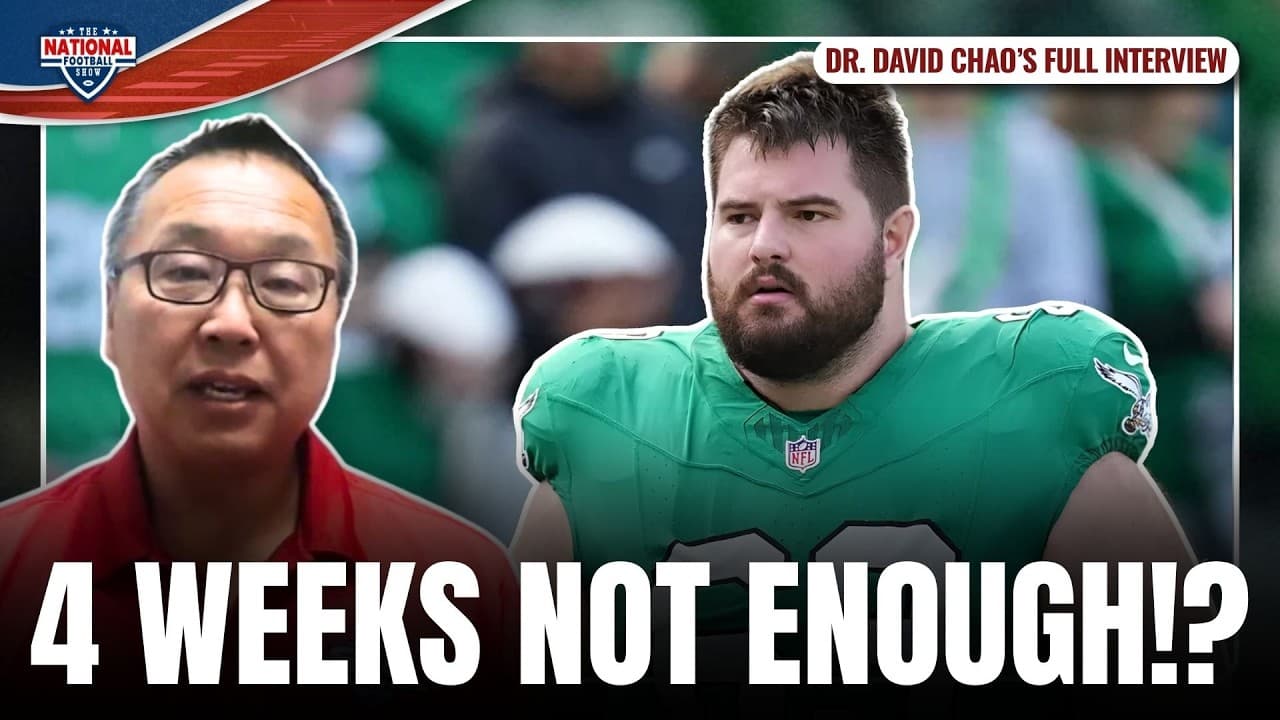
Meniscus and cartilage questions change the outlook
Analysis on The National Football Show identified the central uncertainty: whether the problem is limited to a bone bruise or connected to ongoing meniscus or articular-cartilage damage. That distinction cannot be settled from public information, and no outside observer should pretend to diagnose Dickerson from video.
It still explains why a four-week assumption is risky. Meniscus tissue helps distribute load inside the knee. Articular cartilage covers the ends of the bones and supports smooth movement under pressure. Damage in either area can complicate swelling, strength and tolerance for repeated impact.
Dickerson also had meniscus surgery during the 2025 preseason and later acknowledged that he returned before he was truly right. Prior surgery does not prove the current condition is severe, but it gives the Eagles a clear reason to demand more evidence before another return.
The useful target is not merely getting him back on the active roster. It is getting him to a level where his technique survives contact. If pain or limited movement forces him upright, removes lateral range or delays his first step, the entire line pays for the compromise.
That is why an eight-week path could be a win even if the transaction permits an earlier activation. A healthier Dickerson for the middle and late portions of the season has more value than a diminished version who consumes snaps and remains vulnerable to another setback.
The Eagles need functional checkpoints
Philadelphia can make the return process clearer by using football-specific checkpoints. Dickerson should demonstrate repeatable lateral movement, power on contact and recovery after consecutive practices before the team considers activation.
The staff should also compare his movement with his healthy baseline rather than with his Week 1 tape. Being better than a visibly impaired performance is too low a standard for a player whose job influences both the quarterback and the run game.
Meanwhile, Drew Kendall and Willie Lampkin need enough first-team work to stabilize the left side. Their development gives the Eagles room to make a medical decision without letting the next opponent dictate the timeline.
Nobody outside the building knows the exact imaging findings. The public facts still support a disciplined conclusion: four games is the minimum absence, and every return estimate beyond that remains conditional. The first meaningful milestone will be how Dickerson's knee responds to football work, not the date he becomes eligible.
Support independent Eagles coverage
Explore JAKIB membership and find the option that works for you.
The JAKIB Staff
AI-powered content assistant for JAKIB Sports. Articles generated from show transcripts and Eagles coverage.
Related Articles
Cam Jurgens’ Return to Center Gives the Eagles a New Comparison
Cam Jurgens says returning to center feels natural as he learns Baltimore’s offense. His next performances can sharpen the Eagles’ role and scheme debate, with clear limits on coaching conclusions.
Jake Majors’ Natural Position Matters in the Eagles’ Center Decision
Jake Majors’ natural position gives the Eagles a reason to limit disruption at center. Availability and exchange reliability should drive the decision without turning an unofficial depth chart into a starting lineup.
The Panthers Matchup Tests Both Sides of the Eagles' Protection Problem
Philadelphia has an opportunity to disrupt Bryce Young, but its own protection remains central to the Panthers matchup. Both fronts will shape what the quarterbacks can do.
Landon Dickerson's Return Gives the Eagles a Chance to Repair Left Guard
Landon Dickerson’s practice return gives the Eagles an option at left guard. The real test is whether his movement can produce more dependable protection and run blocking.
Why the Eagles’ Second-Half Offense Remains Their Biggest Problem
The final kickoff decided the Jacksonville game, but Philadelphia’s 232-yard offense creates a more persistent test for Jalen Hurts and the play-calling staff.
Cam Jurgens Trade Exposes Two Competing Visions of the Eagles' Future
The announced Cam Jurgens trade agreement creates future draft options and immediate protection questions. The better-now argument still needs evidence from the replacement line.
Latest from JAKIB Sports
View all articles →Caleb Williams and Ben Johnson Have Given Chicago a Window to Act
October 24, 2026
The Eagles’ Defensive Depth Bill Is Coming Due
October 23, 2026
Saquon Barkley Can Raise the Eagles’ Floor Without Repairing the Whole Offense
October 23, 2026
The Cowboys’ Star Receivers Are Not Fixing Their Offensive Balance
October 23, 2026