
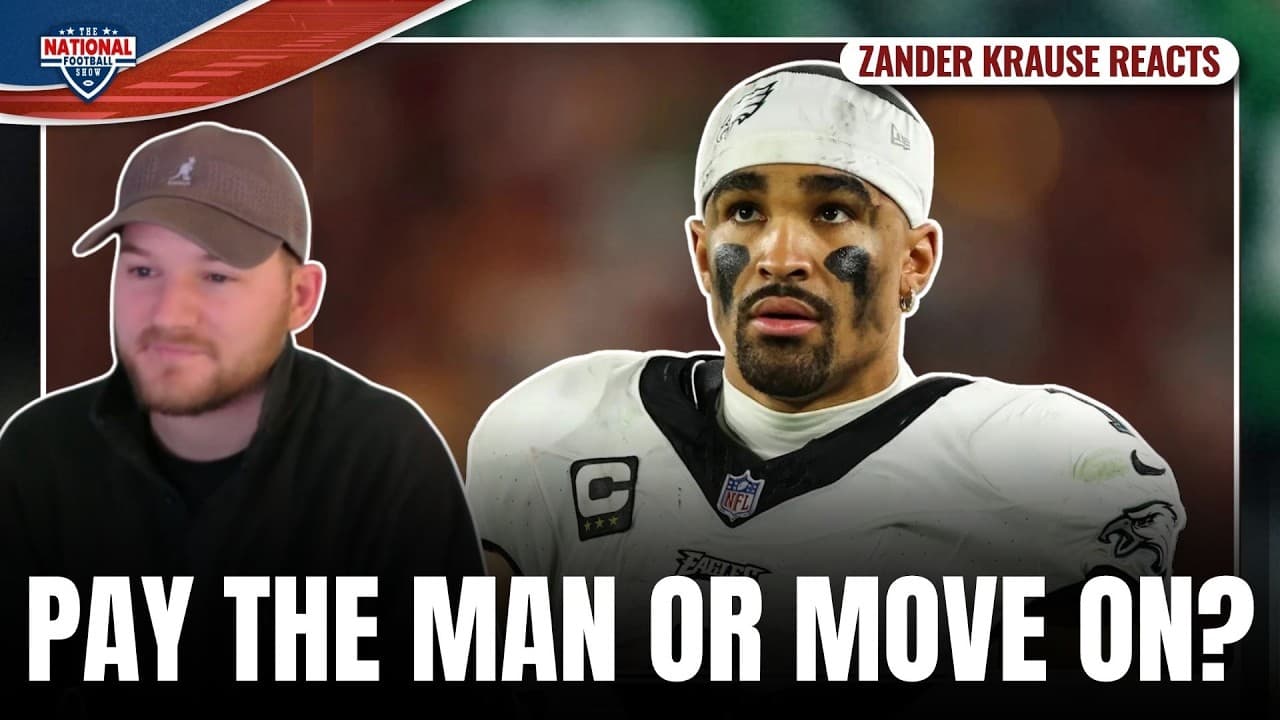
Jalen Hurts’ Next Contract Is About More Than Two Games
Jalen Hurts’ next contract cannot be judged from only two games in the Eagles’ new offense Eight quarters may reveal how Sean Mannion’s system is functioning, but they are too small a sample to settle the value of a quarterback with a longer record of winning.
The JAKIB Staff
contributor
Jalen Hurts’ next contract cannot be judged from only two games in the Eagles’ new offense. Eight quarters may reveal how Sean Mannion’s system is functioning, but they are too small a sample to settle the value of a quarterback with a longer record of winning. Philadelphia also has to separate Hurts’ play from the support around him.
That distinction is the center of the debate. A productive start does not automatically justify an immediate extension, and a flawed afternoon does not erase a broader body of work. The Eagles need a decision framework that measures what Hurts controls, what the offense asks of him and what the roster can reliably provide.
Eight quarters answer a narrow question
Two games can show whether a quarterback is reading the new structure comfortably. They can reveal timing with receivers, pocket choices and how efficiently the offense handles ordinary downs. They cannot establish a complete season trend, especially while a new coordinator’s tendencies are still developing.
Mannion’s offense also will not face the same looks every week. Defenses adapt once they see which concepts Philadelphia favors. The true evaluation comes when an opponent takes away the early answer and Hurts has to find a second one. A contract decision based on the opening fortnight would ignore that adjustment cycle.
The danger runs in both directions. Treating a good start as definitive can overstate what has been proven. Treating two uneven games as proof that Hurts is not worth a future commitment can discount years of high-leverage performance. Neither shortcut gives Roseman a clean picture of the player or the price.
A better sample tracks repeatable decisions. Does Hurts identify pressure and find the correct answer? Does he create value when the first read is covered? Can he keep the offense functional when a clean pocket or a dominant rushing lane is unavailable? Those questions matter more than a single box-score line.
Support changes the meaning of production
The Eagles’ supporting cast affects every part of that evaluation. Line continuity, receiver availability and the health of the running game shape the conditions under which Hurts plays. When protection holds, a quarterback can work through a full progression. When the interior collapses, the same call may become a scramble or a rushed checkdown.
That context should not excuse every mistake. A franchise quarterback is paid to solve difficult situations, and Hurts has to make efficient choices even when the surroundings are imperfect. But it does mean that one rough possession cannot be read without asking whether the design, the protection or the quarterback created the problem.
Philadelphia’s offensive line is a particularly important variable. If the unit cannot create dependable early-down movement, the offense will ask Hurts to rescue more snaps in obvious passing situations. If it recovers its physical control, his efficiency may improve without any change in his underlying ability. The front office should separate those effects before assigning long-term value.
The same principle applies to playmakers. A thinner group reduces the margin for error. That makes Hurts’ ability to extend plays more valuable, while also making simple statistical comparisons with better-supported seasons less informative. The correct question is how much of the offense he creates, not merely how much the offense produces.
A contract is a forecast, not a reaction
An extension would be a judgment about future seasons, roster flexibility and the cost of alternatives. Philadelphia cannot make that judgment by treating the most recent eight quarters as the entire file. The team has to compare Hurts’ established strengths with the demands of Mannion’s system and the resources available to build around him.
Waiting for a larger sample is not the same as dismissing his résumé. It is a way to learn whether the new offense helps him sustain efficient decisions as opponents adjust. A measured evaluation can credit wins and high-pressure performances without pretending every current concern is already resolved.
The Bears game offers a useful next data point, not a final verdict. Watch how Hurts handles changing coverage, protection stress and down-and-distance problems. Those answers will make the contract conversation sharper than either instant celebration or an eight-quarter indictment.
Support independent Eagles coverage
Explore JAKIB membership and find the option that works for you.
The JAKIB Staff
AI-powered content assistant for JAKIB Sports. Articles generated from show transcripts and Eagles coverage.
Related Articles
Eagles' Offensive Line Problems Make the Sean Mannion Verdict Harder
Philadelphia's blocking problems complicate the evaluation of Sean Mannion and Jalen Hurts. Personnel limitations matter, but they do not erase questions about the offense's responses.
The Eagles' Offensive-Line Succession Problem Has Reached Jalen Hurts
The Eagles' offensive-line succession problem has reached Jalen Hurts. Replacing veteran talent now affects the quarterback's protection, the running game's reliability and what Philadelphia can reasonably ask its offense to execute.
Four Games Could Decide Howie Roseman's Trade-Deadline Approach
Four games could decide how Howie Roseman approaches the trade deadline. The Eagles' next stretch should clarify whether a valuable offer serves a realistic playoff push or a roster that needs a faster reset.
The Eagles' Second-Half Collapse Is More Than an Injury Problem
The Eagles' second-half collapse is more than an injury problem. Philadelphia's offense has to produce answers after its opening success, not just explain why the available personnel changed.
The Eagles’ Bigger Problem Beyond the Final Kickoff
The kickoff decision deserves scrutiny, but Philadelphia’s recurring offensive breakdown matters more. Hurts, the staff and the line all face a more durable test.
Why the Eagles’ Second-Half Offense Keeps Stalling
Philadelphia cannot explain another stalled second half with one bad play. The Eagles need a repeatable early-down plan and real counters when a defense adjusts.