
Why the Eagles Keep Losing Their Offensive Rhythm After Halftime
The Eagles’ halftime problems raise a specific question: can their offense answer defensive adjustments? Examine quarterback execution, connected play design and the limits of claims about coaching interference.
The JAKIB Staff
contributor
The Philadelphia Eagles’ second-half offensive problem is bigger than one bad possession. When an offense repeatedly loses its rhythm after halftime, the question becomes whether its answers survive an opponent’s adjustments.
The Bears discussion in Wednesday’s National Football Show returns to that distinction. Early progress and isolated successful plays can coexist with an offense that struggles to sustain its approach. The concern is not simply that something went wrong. It is that the response appears disconnected from what worked before the break.
That puts Nick Sirianni, Sean Mannion and Jalen Hurts inside the same conversation. Coaching decisions shape the opportunities. Blocking and quarterback execution determine what happens when those opportunities arrive. Separating those responsibilities is useful; pretending only one exists is not.
A good opening is not a complete offensive plan
An opening script lets an offense present carefully chosen looks. Those plays can test defensive rules, create favorable matchups and establish tendencies. The real examination begins when the defense recognizes the pattern and changes its response.
Philadelphia’s offense cannot treat early production as proof that the entire plan is sound. A successful running concept should create information for later possessions. If the defense changes its front, the offense can adjust the blocking, change the point of attack or use a complementary pass.
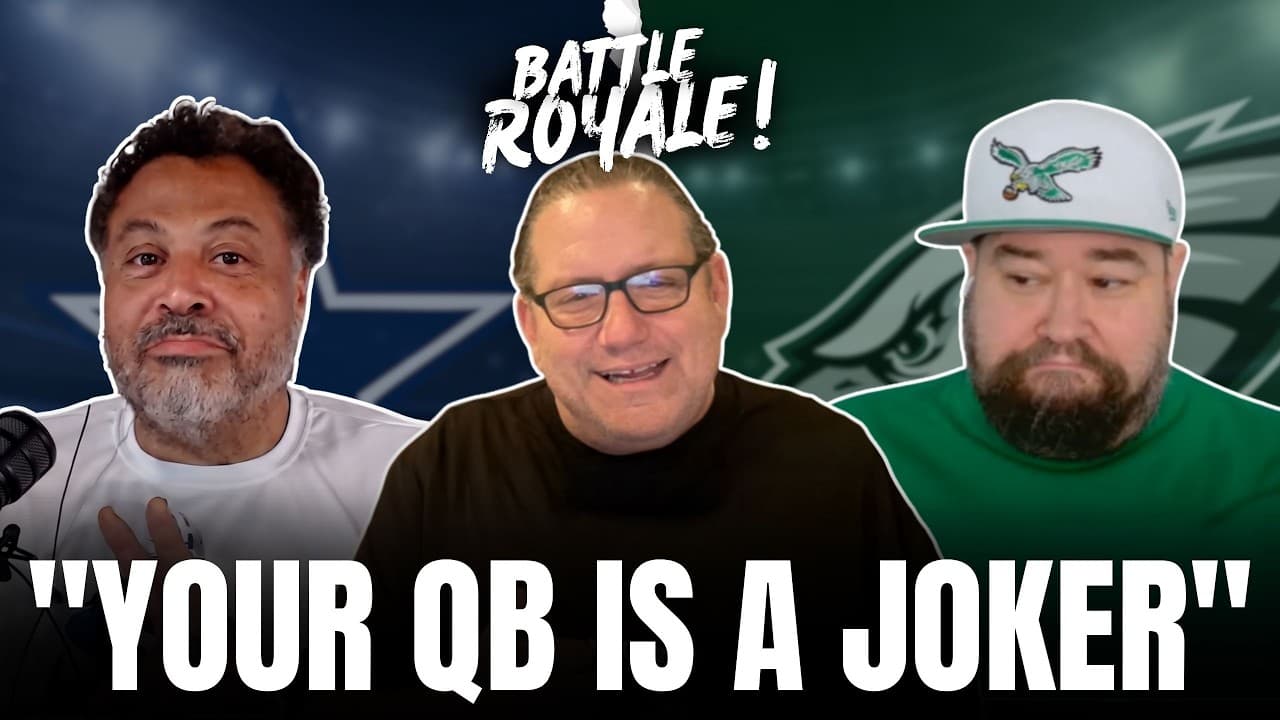
The Battle Royale discussion focuses on the contrast between an effective early running approach and a second half that looked different. That is a football question worth examining without turning every change into a conspiracy. A defense might have removed the original opportunity. The score and available personnel might have changed the call. Those explanations still require a coherent replacement.
If the next series abandons a productive idea, the alternative should exploit the defensive adjustment that forced the change. Otherwise the offense gives away the information it collected. Philadelphia ends up starting over instead of building on its own success.
Hurts belongs in the evaluation, too
Hurts can rescue a possession with movement and an off-script throw. That ability matters when protection breaks down. It also makes the offense harder to diagnose, because a successful scramble can hide a play that never developed as intended.
A productive drive does not automatically validate the design. A failed drive does not automatically mean the coordinator called the wrong plays. The useful questions are more specific: Was the protection clear? Did the quarterback recognize the coverage? Was there an available answer? Did the receiving option create the separation the play required?
Hurts carries responsibility for the decisions he controls. The staff carries responsibility for giving those decisions a realistic chance. An offense built around his strengths should not depend on him improvising its structure every week.
Saquon Barkley adds another part of that calculation. A credible running threat can change the defense’s spacing and make the passing picture easier. That does not mean running regardless of the front. It means explaining how the run and pass choices help each other, especially after the opponent changes its approach.
Interference is a theory, not an established explanation
One argument in the discussion is that Sirianni’s involvement disrupts the offense’s second-half identity. That remains an interpretation, not proof of who selected a particular play. The source does not establish the internal communication behind every decision.
It is fair to evaluate the head coach’s offensive direction without inventing a private chain of command. Sirianni is responsible for the operation, including how the staff resolves disagreements. Mannion is responsible for the offensive plan within that operation. Neither responsibility disappears because the other person has influence.
The next useful test is observable. Does Philadelphia retain productive concepts, answer altered fronts and produce possessions that fit together? Or does each series look like a fresh search for an identity?
Against the Rams, the Eagles’ first successful drive will only begin that evaluation. The more revealing sequence comes after Los Angeles changes the picture. Philadelphia’s response can show whether it has a connected plan for the whole game, rather than another promising half.
Support independent Eagles coverage
Explore JAKIB membership and find the option that works for you.
The JAKIB Staff
AI-powered content assistant for JAKIB Sports. Articles generated from show transcripts and Eagles coverage.
Related Articles
The 2017 Eagles' Locker-Room Lesson for a Team Losing Its Leaders
The 2017 Eagles offer a useful example of players supporting one another in crisis. Applying that lesson today requires a fair evaluation of Jordan Mailata and honesty about what outsiders cannot know.
Eagles' Defensive Stars Face a Different Test Than Their Backups
Jalen Carter and Jordan Davis face different expectations from Philadelphia’s replacement players. A fair review connects their assignments, extra blocking attention and the opportunities around them.
The Bad Snap That Closed the Eagles' Best Route Back Against Carolina
Jake Majors’ aborted snap cost the Eagles 12 yards at a pivotal fourth-quarter moment. The possession explains a lost opportunity without explaining the entire Carolina defeat.
Howie Roseman’s Roster Reset Still Needs Immediate Impact Players
Howie Roseman’s roster reset needs players who contribute now as well as future flexibility. The Eagles’ additions, departures and retention decisions solve different problems and deserve separate evaluation.
What Nick Sirianni’s Preparation Shows Beyond the Eagles’ Final Scores
Nick Sirianni’s weekly preparation deserves scrutiny alongside the Eagles’ results. Evaluating the full head-coaching job also means keeping a hypothetical future reset separate from the current assignment.
Jake Majors’ Natural Position Matters in the Eagles’ Center Decision
Jake Majors’ natural position gives the Eagles a reason to limit disruption at center. Availability and exchange reliability should drive the decision without turning an unofficial depth chart into a starting lineup.