
The Eagles' Makeshift Offensive Line Turns Jacksonville Into a Protection Test
The Eagles face Jacksonville with an offensive line in transition. Center uncertainty and Markel Bell's development will shape how Philadelphia protects Jalen Hurts.
The JAKIB Staff
contributor
The Eagles' makeshift offensive line makes Jacksonville a test of whether Jalen Hurts can operate the offense before pressure changes the play. Replacing familiar names is only part of the challenge; Philadelphia also has to rebuild the communication that holds a protection together.
Lane Johnson announced his retirement Tuesday. The Eagles then announced an agreement to trade Cam Jurgens to Baltimore, pending a physical. Those are separate departures with the same immediate consequence: less continuity in a unit that once provided the offense's most dependable advantage.
The next lineup is still a projection, not a confirmed starting five. Thursday's injury report listed Drew Kendall as a nonparticipant with a knee injury and Fred Johnson as limited with a knee injury. That distinction matters before declaring who will play center or right tackle in London.
Center uncertainty changes the whole protection
The center's job extends beyond snapping the ball. Interior combinations depend on recognizing where pressure can arrive, communicating assignments and passing defenders between blockers. A new combination can execute each individual block reasonably well and still surrender pressure through a missed exchange.
Kendall had already taken over at center after Jurgens moved to left guard following Landon Dickerson's placement on injured reserve. The trade therefore removes more than a name from the depth chart. It narrows the available answers while the Eagles are already rearranging the interior.
Philadelphia's announcement identified Willie Lampkin and Micah Morris as options to help reshuffle the line. An option is not a game-day assignment. Practice availability and the final lineup should determine the preview, rather than treating a proposed replacement as a settled starter.
Jacksonville can test that uncertainty without winning every matchup outright. A defense can threaten one gap, bring pressure elsewhere and force a new unit to agree on the same answer. When the protection slides one way and a blocker expects another, the quarterback loses time before a receiver finishes his route.
Markel Bell needs support, not a Lane Johnson comparison
The Eagles' retirement announcement put rookie Markel Bell in line for another start after his full-game appearance against the Rams. That creates an opportunity for development. It does not establish that Philadelphia has upgraded at right tackle.
Bell can make useful blocks and still need help against difficult situations. Judging him against Johnson's reputation misses the practical question: which assignments can the offense ask him to handle now, and which require a tight end, running back or quicker throw?
Protection help carries a price. A tight end who stays in cannot immediately threaten the middle of the field. A running back checking a rusher is slower to become an outlet. Keeping more players near the quarterback can protect Hurts while reducing the passing options available to beat coverage.
That tradeoff becomes sharper on obvious passing downs. A short completion on first down can keep the offense moving. The same throw on third-and-long may leave Philadelphia punting, even if it prevents a sack. Early-down efficiency is part of protecting a young tackle, not a separate concern.
The answer is a workable offense, not a perfect line
Dallas Goedert's anticipated return offers a useful possibility, but Thursday's report still listed him as limited. Saquon Barkley and DeVonta Smith did not participate. Expectations about healthier weapons should not become confirmed availability before the team supplies that information.
Philadelphia can help the line with rhythm throws, clearer reads and formations that reveal pressure intentions. Those choices also need credible counters. If Jacksonville can anticipate every quick throw, it can crowd the throwing lanes and force Hurts to hold the ball anyway.
The running game belongs in that conversation. Effective combinations can keep the offense ahead of the chains and limit the defense's freedom to attack. Repeated negative runs accomplish the opposite, turning a protection problem into a predictable passing situation.
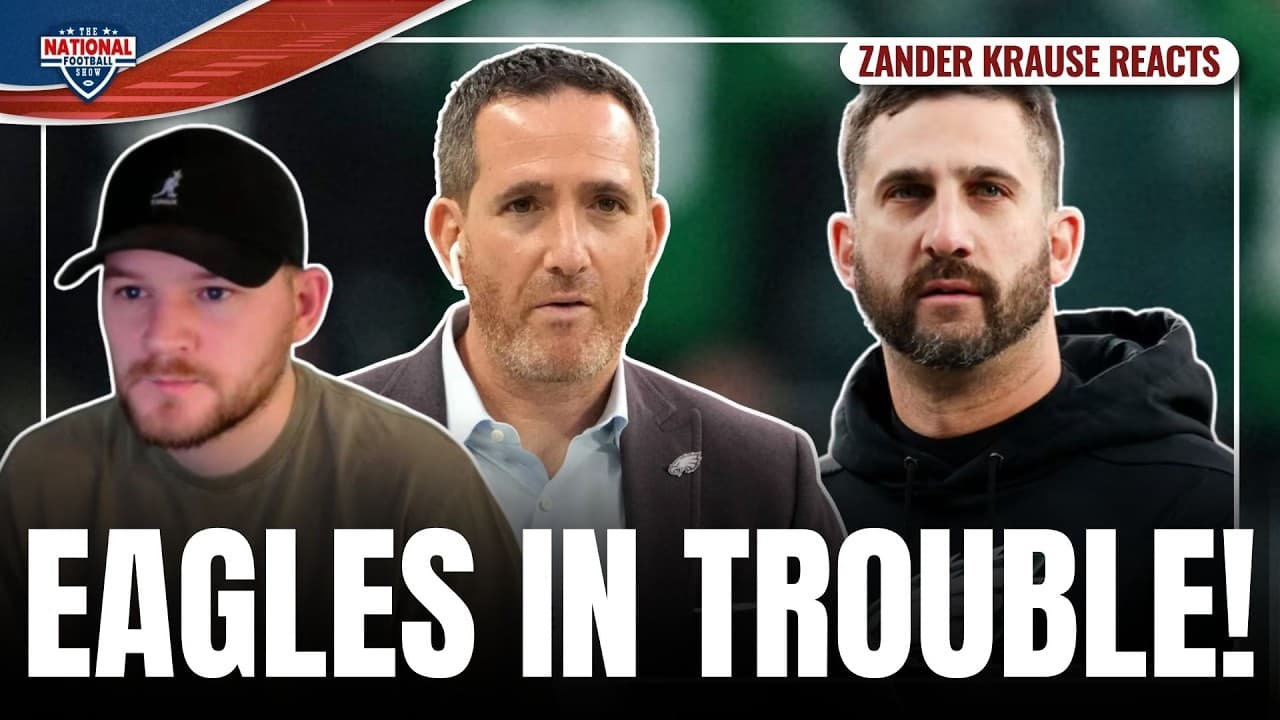
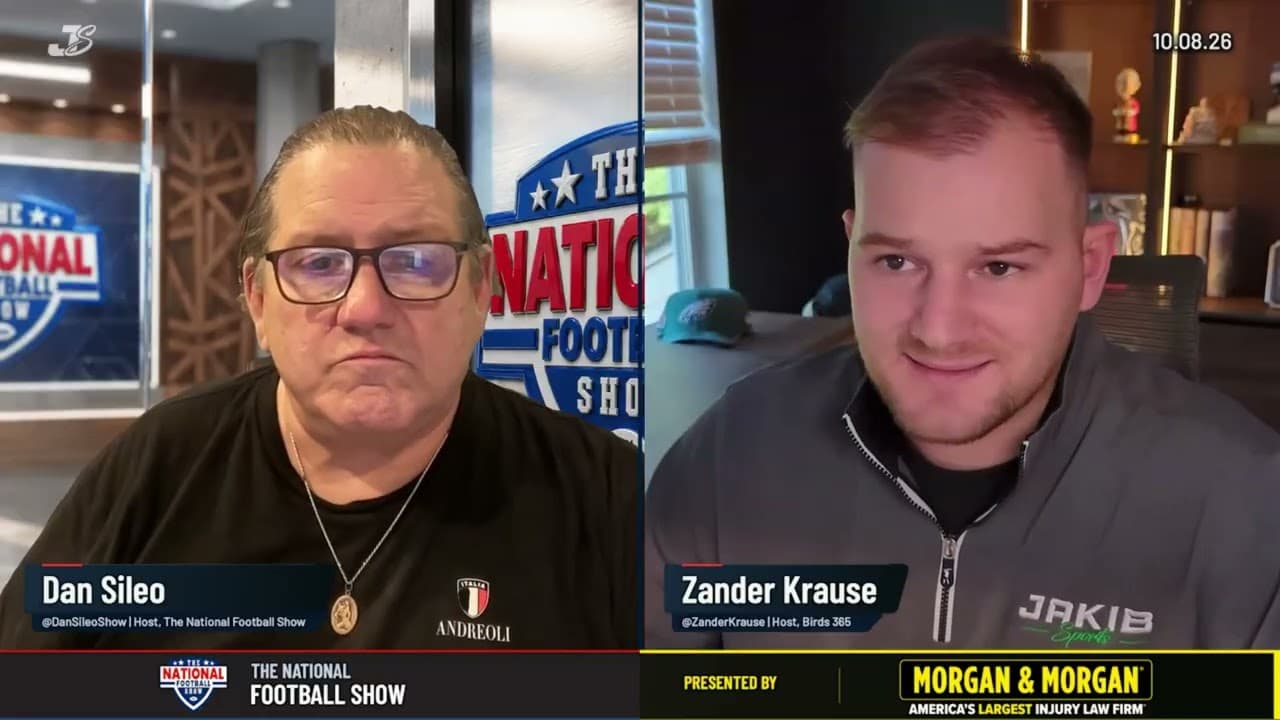
The National Football Show's debate centers on whether the Eagles are still built to contend while multiple line positions are being evaluated. London's first evidence will be more specific: how the actual starting group communicates, whether Bell receives useful help and whether Hurts gets enough clean early-down snaps to keep the playbook open.
Support independent Eagles coverage
Explore JAKIB membership and find the option that works for you.
The JAKIB Staff
AI-powered content assistant for JAKIB Sports. Articles generated from show transcripts and Eagles coverage.
Related Articles
The Eagles' Offensive Identity Problem Complicates Jalen Hurts' Evaluation
Jalen Hurts’ decisions, the protection plan and the Eagles’ route concepts need separate evaluation. Their shared timing will reveal whether Philadelphia is building a coherent offense.
What the Cam Jurgens Trade Changes for the Eagles' Offensive Line
The Cam Jurgens deal adds future picks and financial flexibility. Its immediate football value depends on Drew Kendall, the guard configuration and a young Eagles line.
The Eagles' Offensive-Line Reset Changes Jalen Hurts' Leverage
Philadelphia's changing offensive line affects the football support around Jalen Hurts. Contract and agent-shopping scenarios remain analysis, not evidence of a trade request.
The Eagles’ Young Offensive Line Is an Evaluation, Not a Finished Rebuild
Giving Drew Kendall, Willie Lampkin and Markel Bell an opportunity does not make the Eagles’ offensive line a finished rebuild. Philadelphia is collecting evidence about its next starters while asking the current offense to remain competitive.
The Eagles’ Offensive-Line Reset Is About More Than Replacing Lane Johnson
Replacing Lane Johnson requires an immediate protection plan and a longer-term investment decision. The Eagles also have to account for the rest of the line, not isolate every problem at right tackle.
Jalen Hurts’ Development Tests the Eagles’ Offensive Structure
Jalen Hurts' development tests the Eagles' offensive structure because quarterback improvement depends on more than the player's individual work. Philadelphia also has to provide clear rules, connected concepts and a coaching operation that turns corrections into usable answers.