
Why Drake Maye Raises the Standard for the Eagles' Passing Game
Drake Maye's command of New England's passing game gives Philadelphia a useful comparison point, not a quarterback-ranking stunt. The Eagles must build a system that lets Jalen Hurts attack with the same clarity and aggression.
The JAKIB Staff
contributor
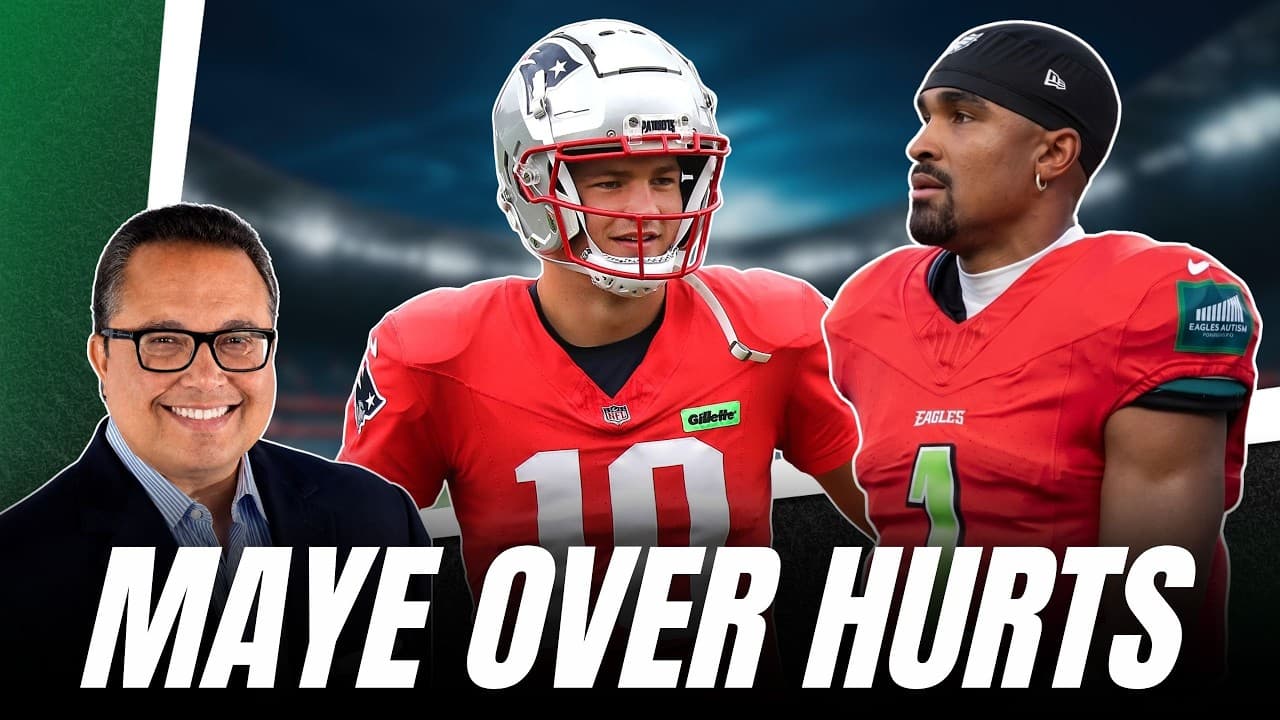
Drake Maye raises the standard for the Eagles' passing game because New England has given its quarterback a clear structure and premium tools. The comparison with Jalen Hurts should not be reduced to a daily ranking or a joint-practice score. It should force Philadelphia to ask a more useful question: is its new offense creating the same kind of conviction, spacing and downfield opportunity for its own quarterback?
Maye enters his third season after a major second-year jump, and the Patriots reinforced that progress by acquiring A.J. Brown from the Eagles. Their connection was visible throughout New England's summer work and again during the joint practices. Brown gives Maye a receiver who can win early in the route, threaten deep and turn a contested window into a reasonable decision. The quarterback still must deliver, but the design gives him an aggressive answer.
The Standard Is Clarity, Not Imitation
Philadelphia does not need to copy Josh McDaniels' call sheet or ask Hurts to become Maye. The two quarterbacks win differently. Maye's pocket movement and willingness to drive the ball into intermediate windows fit New England's structure. Hurts brings a stronger designed-run threat, powerful movement outside the pocket and experience managing high-leverage games. The challenge for Sean Mannion is to build around those traits without shrinking the passing menu.
A good system tells the quarterback where the answer should appear and gives him a disciplined progression when the defense changes the picture. It also makes coverage declare itself through formation, motion and route spacing. Hurts should not have to create clarity after the snap on every important down. The offense must do some of that work before the ball is in his hands.
Brown Shows What a Featured Target Changes
Brown's move to New England makes the contrast impossible to ignore. A featured receiver changes the geometry of a passing game because defenses must account for him on every snap. New England can isolate Brown, use his gravity to create space elsewhere or trust him when the coverage is technically correct. Philadelphia no longer has that exact piece, so Mannion must manufacture stress through the full group instead of waiting for one receiver to dominate an isolated matchup.
That means DeVonta Smith, the tight ends, backs and complementary receivers must be connected rather than deployed as separate ideas. Routes should create conflict for underneath defenders. Play action should resemble the runs Philadelphia actually intends to feature. Shot plays should emerge from formations the defense has already learned to respect. Hurts is at his best when the aggression has a clear purpose, not when every explosive attempt depends on improvisation.
The Eagles Must Expand Without Losing Their Base
The encouraging part is that Philadelphia does not need to choose between a serious passing game and its run-first identity. The offensive line and Saquon Barkley can force defenses into heavier boxes and simpler structures. That should create opportunities for Hurts to attack beyond the sticks. The run game supplies leverage; the passing game must cash it in. If those two elements remain disconnected, the Eagles will waste their greatest schematic advantage.
The preseason should reveal whether that connection is becoming automatic. The important indicators are not raw passing totals. Watch whether Philadelphia reaches the line with time, whether receivers arrive at complementary landmarks and whether Hurts can move directly from his first read to a sensible answer. Efficient process in August is more meaningful than a collection of isolated highlight throws.
Maye's summer is useful because it shows what organizational alignment looks like around a young quarterback: a defined system, a premium receiver and permission to attack. Philadelphia has different personnel and a more experienced quarterback, but the expectation should be just as high. Give Hurts clean answers, use the run to shape coverage and let the ball threaten every level of the field. The Eagles do not have to prove Hurts is Maye. They have to prove their passing game is built to maximize the quarterback they chose.
Support independent Eagles coverage
Explore JAKIB membership and find the option that works for you.
The JAKIB Staff
AI-powered content assistant for JAKIB Sports. Articles generated from show transcripts and Eagles coverage.
Related Articles
Jeff Stoutland’s Absence Raises a Bigger Eagles Continuity Question
Jeff Stoutland’s departure puts the Eagles’ offensive-line continuity under scrutiny. The current staff’s task is to transfer knowledge and build reliable combinations without treating retirement and trade counterfactuals as facts.
The Eagles' Dickerson Injury Story Raises a Bigger Trust Problem
Philadelphia placed Landon Dickerson on Injured Reserve after saying his bone bruise was discovered through a postgame MRI. The timing leaves the Eagles with a larger accountability problem involving evaluation, preparation and public trust.
Why A.J. Brown No Longer Looks Like the Same Receiver
A.J. Brown's Patriots debut supplied evidence for concern, but not a complete verdict on his decline. The real evaluation has to separate a small, injury-shortened sample from changes that were already visible late in Philadelphia.
Why A.J. Brown's Eagles Exit Still Feels Unfinished
A.J. Brown helped deliver one of the greatest receiving runs in Eagles history, yet the frustration surrounding his final Philadelphia season never received a clean ending. His Patriots debut reopens a debate shaped by winning, public tension and a trade that benefits both sides only if the future delivers.
Why A.J. Brown and Jalen Hurts Face the Same Test Without Each Other
A.J. Brown and Jalen Hurts begin separate chapters with the same burden: prove their old partnership was not carrying the other side. New England needs Brown to elevate its passing game, while Philadelphia needs Hurts to command a rebuilt receiving group.
What A.J. Brown's Practice Dominance Means for Quinyon Mitchell
A.J. Brown's repeated wins against Quinyon Mitchell created an uncomfortable but valuable test for the Eagles' top corner. The joint practices offered a lesson in elite receiver play, not a final verdict on Mitchell.
Latest from JAKIB Sports
View all articles →The 2017 Eagles' Locker-Room Lesson for a Team Losing Its Leaders
October 19, 2026
Eagles' Defensive Stars Face a Different Test Than Their Backups
October 19, 2026
The Bad Snap That Closed the Eagles' Best Route Back Against Carolina
October 19, 2026
Chicago’s Quarterback Decision Tests Ben Johnson’s System Fit
October 17, 2026