
Can Sean Mannion’s Offense Work With the Eagles’ Current Personnel?
Sean Mannion's motion and play-action concepts need blocking and timing that Philadelphia has not consistently supplied. The Bears loss made the fit between the scheme and the current offensive line impossible to ignore.
The JAKIB Staff
contributor
Sean Mannion's offense can work with Philadelphia's current personnel only if its blocking and timing match the ambition of its design. Motion, screens and under-center play action can create easier throws for Jalen Hurts. Against Chicago, too many possessions ended before those ideas could build on one another, leaving the Eagles with seven points in a 27-7 loss.
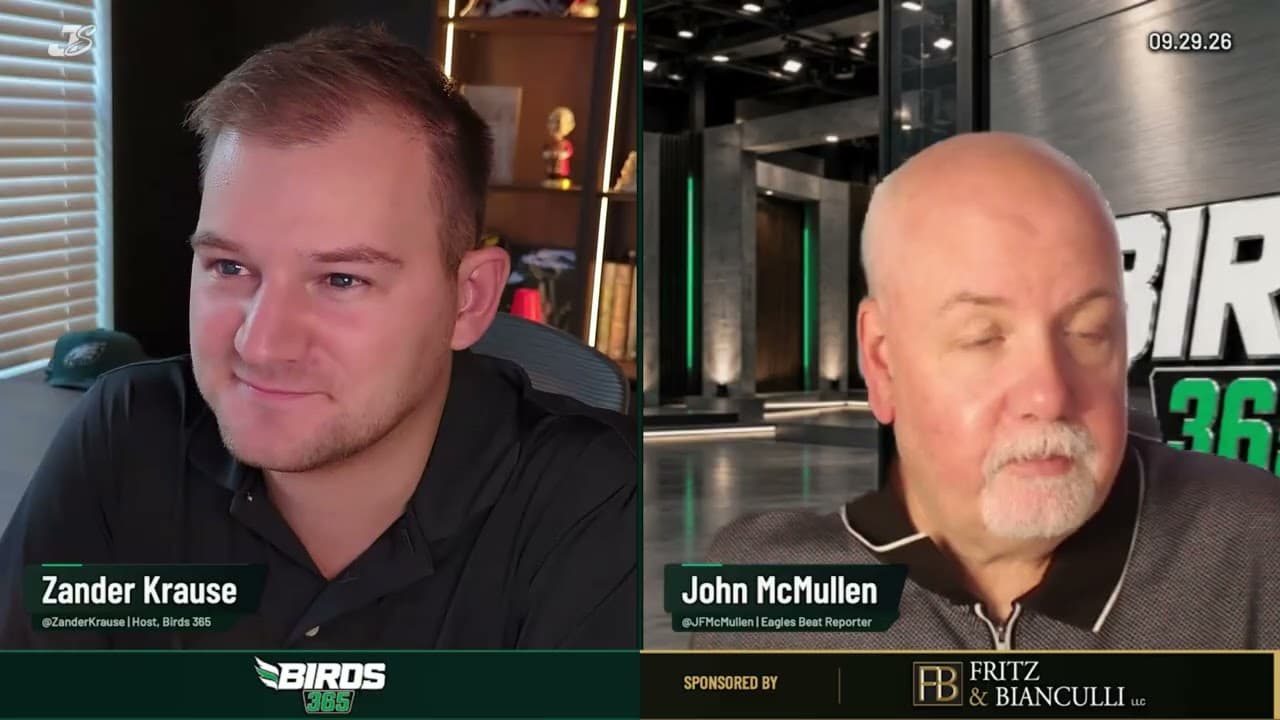
The Birds 365 line discussion focuses on Cam Jurgens at left guard, Drew Kendall at center and the difficulty of asking the present group to execute a particular motion concept. Its central distinction is useful: a clever design is not proof that the roster can perform every block and timing detail required. The broader offensive discussion asks whether this is a persistent personnel fit problem rather than one poor night.
A promising concept still needs an answer up front
Motion can reveal a coverage response and change a defender's leverage. A screen can punish an aggressive rush. Play action from under center can make a run threat look real. None of those effects is automatic. The ball carrier has to hit the right landmark, the line has to sell or release at the right time, and Hurts needs a clean enough picture to finish the play.
The Bears game showed two different versions of the Eagles' offense. Saquon Barkley gained 73 of his 82 rushing yards before halftime, according to the Eagles' Tuesday review. Hurts then led a late scoring drive that included a 30-yard DeVonta Smith catch and a nine-yard Zach Ertz completion. Those plays show the roster has useful parts. They do not prove the unit can repeat them over four quarters.
After halftime, Philadelphia opened with consecutive three-and-outs and then punted again. The official game recap records a Hurts sack before that third punt. In that stretch, a playbook built to manipulate defenders had little chance to develop. Down-and-distance kept becoming a constraint before the Eagles could chain a run, a movement play and a counter together.
The guard-center fit is a coaching decision
Jurgens' work at left guard and Kendall's role at center deserve a direct evaluation, not a reflexive verdict on one player from one game. Interior movement affects the timing of both the run game and the protection pocket. If the left guard is late or loses leverage, the quarterback feels pressure before a longer-developing concept can pay off. If the center and guard do not pass off a stunt cleanly, even a well-drawn protection can fail.
Those observations do not establish the precise cause of every Chicago pressure. Without a complete assignment grade, labeling an injury or naming one blocker on each negative play would be speculation. The staff can still ask a clear personnel question: does the current alignment put its best combination on the field, or does it ask an effective player to perform a different job at a cost to the whole line?
Mannion can respond with fewer long-developing asks while the line settles. That is not surrendering his scheme. It means identifying which pieces are already dependable: the run looks that produced early gains, quick passes with clear protection rules, and motion that actually changes the defense rather than merely decorating the formation. Complexity earns its place when the offense can execute the simpler answer first.
The Rams will show whether the plan is teachable
Philadelphia has not scored in a first quarter through three games, the Eagles' own review notes. The third-quarter stalls against Chicago add another warning. An offense cannot repeatedly wait until a late two-minute drive to prove it has talent. It needs an opening script and a halftime response that its present blockers and receivers can perform at game speed.
The useful test against the Rams is specific. Can the Eagles create a manageable second down with the run, protect Hurts on the next call, and make one motion or play-action look build on the same personnel? If they can, Mannion's concepts have a foundation. If the offense again asks for a perfect block on every clever design while basic drives disappear, the issue is not creativity. It is whether the teaching and lineup fit the players available now.
Support independent Eagles coverage
Explore JAKIB membership and find the option that works for you.
The JAKIB Staff
AI-powered content assistant for JAKIB Sports. Articles generated from show transcripts and Eagles coverage.
Related Articles
Tanner McKee Won’t Get a Clean Test of the Eagles’ Offense
Tanner McKee will be evaluated alongside the Eagles’ protection, route timing and coaching adjustments. The Carolina game can reveal what works for the backup and what the whole offense still needs.
Jeff Stoutland’s Absence Raises a Bigger Eagles Continuity Question
Jeff Stoutland’s departure puts the Eagles’ offensive-line continuity under scrutiny. The current staff’s task is to transfer knowledge and build reliable combinations without treating retirement and trade counterfactuals as facts.
The Eagles’ Second-Half Plan Is Shrinking Jalen Hurts’ Options
The Eagles need a second-half approach that protects the ball without removing their best answers. Coaching design and Jalen Hurts’ decisions both shape whether a lead becomes another possession or another defensive burden.
Eagles' Offensive Line Problems Make the Sean Mannion Verdict Harder
Philadelphia's blocking problems complicate the evaluation of Sean Mannion and Jalen Hurts. Personnel limitations matter, but they do not erase questions about the offense's responses.
The Eagles’ Bigger Problem Beyond the Final Kickoff
The kickoff decision deserves scrutiny, but Philadelphia’s recurring offensive breakdown matters more. Hurts, the staff and the line all face a more durable test.
How the Eagles’ Run-Game Collapse Exposes Their Offensive Line
Philadelphia’s rushing collapse exposed more than a missing run call. The Panthers game will show whether its line can restore manageable downs and a credible run threat.
Latest from JAKIB Sports
View all articles →The 2017 Eagles' Locker-Room Lesson for a Team Losing Its Leaders
October 19, 2026
Eagles' Defensive Stars Face a Different Test Than Their Backups
October 19, 2026
The Bad Snap That Closed the Eagles' Best Route Back Against Carolina
October 19, 2026
Chicago’s Quarterback Decision Tests Ben Johnson’s System Fit
October 17, 2026