
Why the Eagles' New Offense May Not Fit Its Current Personnel
Philadelphia can contend without becoming a carbon copy of the Rams, but Sean Mannion's new offense presents an immediate personnel test. The Eagles may need to build around their power run game before asking an undersized receiver room and thin tight end group to carry unfamiliar jobs.
The JAKIB Staff
contributor
The Philadelphia Eagles can contend this season, but their new offense may be asking the current roster to solve the wrong problem. Sean Mannion's system appears to borrow ideas that require bigger receivers, versatile tight ends and dependable insert blockers, while Philadelphia's clearest strength remains its power run game.
That mismatch does not doom the offense. It does mean Mannion's first job is adaptation. The Eagles should use the concepts that complement Jalen Hurts, Saquon Barkley and the offensive line, then discard anything that depends on personnel they do not have.
The Rams Blueprint Comes With Personnel Requirements
Modern offenses do not copy only formations. They copy the jobs hidden inside those formations. An insert-block run can ask a receiver or tight end to cross the formation, find a defender in traffic and create a clean lane without announcing the play before the snap.
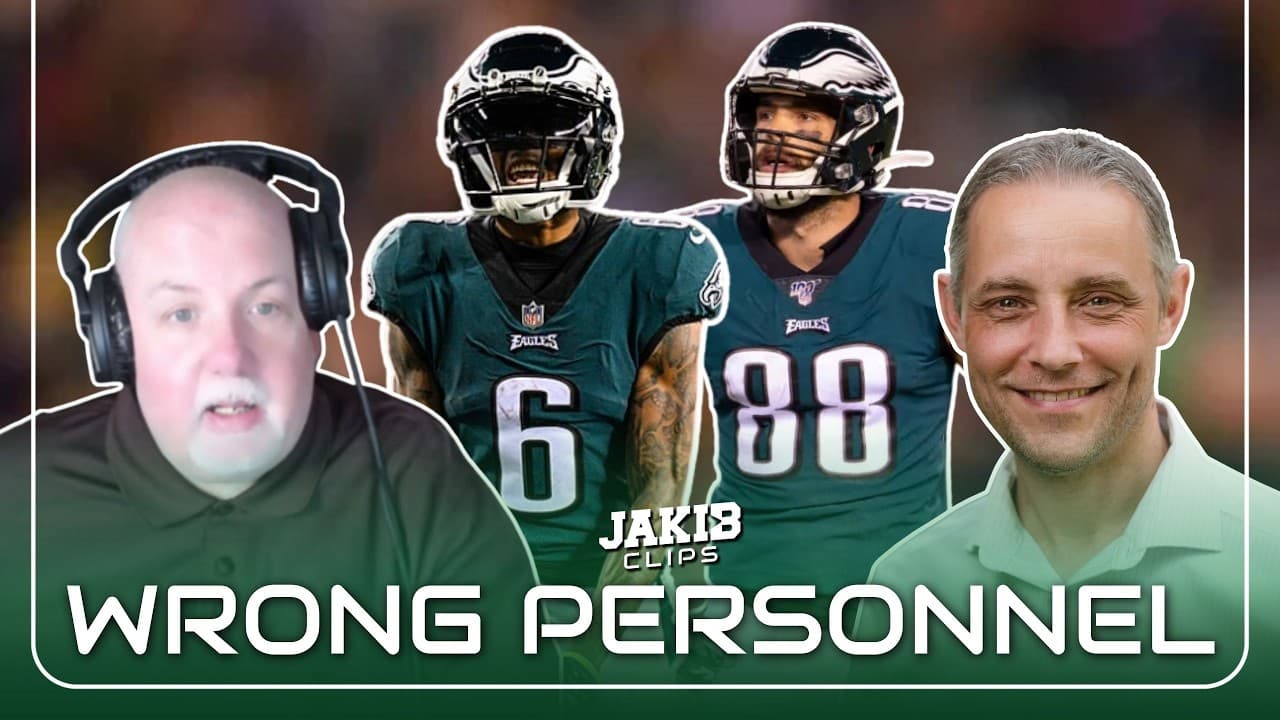
That works when the offense has pass catchers who can threaten coverage and handle contact. Philadelphia enters the season with one established top tight end in Dallas Goedert and an undersized receiver group. Asking those players to reproduce every detail of a different roster's system would turn scheme into a liability.
The concern grows if Goedert misses time. Tight end depth affects far more than the receiving box score in this structure. It changes the offense's ability to shift, disguise strength, block from multiple alignments and force a defense to declare its intentions.
Philadelphia's Power Game Is the Stable Starting Point
The Eagles do not need to abandon Mannion's ideas. They need an order of operations. Start with the offensive line and Barkley, establish the downhill threat, then use motion and insert action to create hesitation rather than treating those devices as the identity of the offense.
A productive running game would give every uncertain part of the passing attack more room. Linebackers would step toward the line. Safeties would become vulnerable to play action. Hurts could attack defined windows instead of carrying an unproven structure through pure dropback volume.
That approach also protects the receiver room. DeVonta Smith can remain the primary target without facing constant extra attention, while Dontayvion Wicks, Makai Lemon and the veteran depth options earn larger roles through execution. The system would create manageable assignments instead of demanding that one secondary target become a complete solution immediately.
Mannion's Flexibility Will Matter More Than His Playbook
The first month should reveal whether Mannion views the scheme as a menu or a mandate. A menu lets the Eagles select the motions, route combinations and blocking tools that fit. A mandate forces players into roles because those roles worked somewhere else.
Hurts is part of that test. He has spent his career in offenses built around his movement, deep-ball ability and control of the run game. A productive transition should expand those strengths. It should not require him to imitate a quarterback with a different processing rhythm and different supporting cast.
Early unevenness would be understandable. Repeating concepts that fail for the same personnel reason would be harder to excuse. Philadelphia has enough talent to score while the system develops, provided the coaching staff recognizes which parts of the experiment are creating answers and which are creating friction. Personnel groupings, down-and-distance choices and protection results should make that distinction visible quickly.
The clearest Week 1 indicator will be who handles the dirty work around the formation. If the Eagles can create movement without exposing their tight end depth or asking small receivers to win repeated collisions, the new offense has a workable bridge. If not, Mannion should lean harder into Philadelphia's line and build outward from the roster's real advantage.
Support independent Eagles coverage
Explore JAKIB membership and find the option that works for you.
The JAKIB Staff
AI-powered content assistant for JAKIB Sports. Articles generated from show transcripts and Eagles coverage.
Related Articles
The Eagles Cannot Develop an Offense on a One-Year Coaching Clock
The Eagles should judge Sean Mannion and the quarterbacks by how quickly they solve recurring defensive problems. Continuity earns its value through clearer answers, not another year on the calendar.
Joe Milton Gives the Eagles a New Test, Not a Clean Slate
Joe Milton changes the Eagles’ options against the Giants. Protection, clear answers and adjustments after the opening script will determine whether the plan holds up.
At 2–6, the Eagles Still Have to Find Out What Their Young Offense Can Do
Makai Lemon, Eli Stowers, Markel Bell and Drew Kendall give the Eagles specific development questions to answer. Sean Mannion belongs in that evaluation too, with progress measured in assignments and decisions as well as production.
Joe Milton Offers a Different Test for the Eagles’ Broken Offense
Joe Milton would give the Eagles another set of tools, but a quarterback change still requires a workable plan. The next Giants game and the bye provide a decision point, not proof that a switch is coming.
Quenton Nelson and Jeffery Simmons Add a New Layer to Bears–Seahawks
Quenton Nelson and Jeffery Simmons add an interior blocking question to Bears–Seahawks. If available, their assignments could affect protection help, combination blocks and opportunities elsewhere along the front.
The Eagles’ Backup Plan Has to Fit the Offense
The Eagles should evaluate their backup quarterbacks by what each allows the offense to keep doing. Dallas provided productive Tanner McKee possessions, while leaving a larger question about continuity behind Jalen Hurts.
Latest from JAKIB Sports
View all articles →Caleb Williams’ Improvement Starts With the Structure Around Him
November 7, 2026
Saquon Barkley’s Value in an Eagles Rebuild Goes Beyond His Stat Line
November 7, 2026
The Eagles’ Backup Quarterback Problem Is Bigger Than One Bad Start
November 7, 2026
Joe Milton's First Eagles Test Includes What Happens Before the Snap
November 6, 2026