
Doug Pederson's Offense Is the Blueprint Sean Mannion Should Follow
Sean Mannion comes from the Shanahan-McVay coaching tree, but the best version of the Eagles' offense might look more like what Doug Pederson built — a hybrid system tailored to the roster's strengths.
The JAKIB Staff
contributor
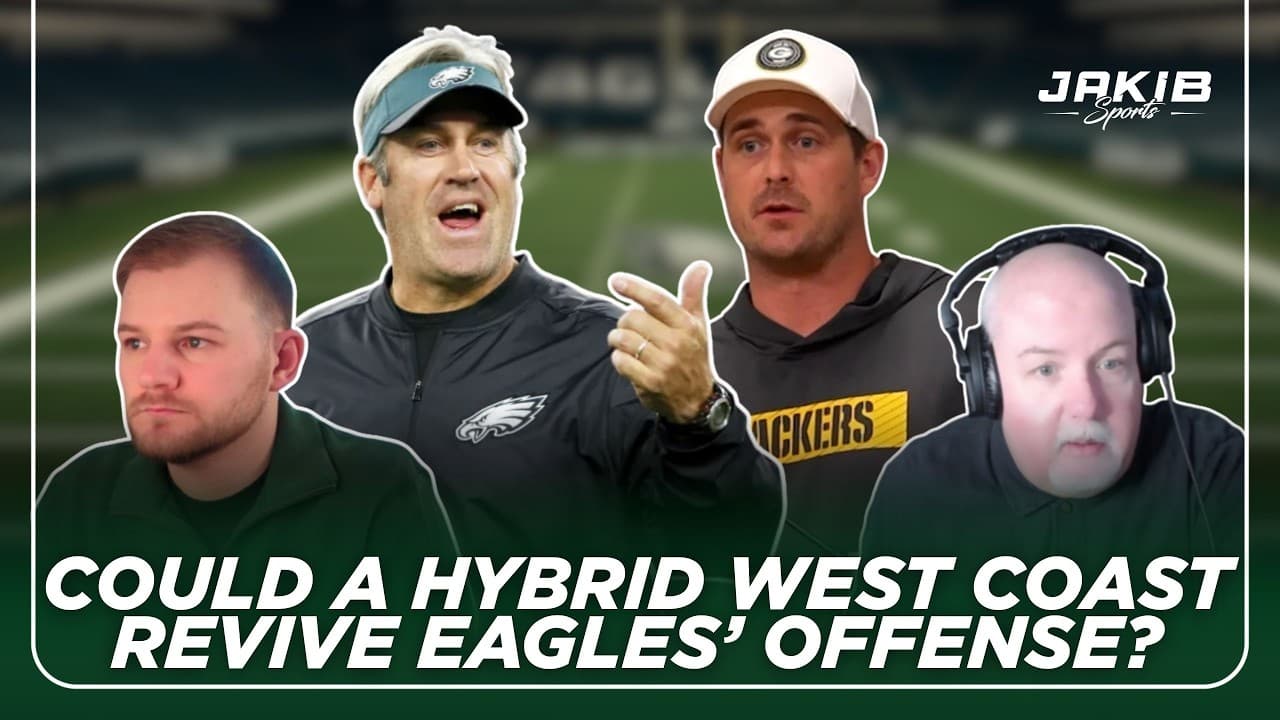
Everyone keeps calling Sean Mannion a "Shanahan guy." And he is — that's his coaching lineage, his schematic foundation, the system he learned under. But if Mannion is actually a good offensive coordinator, the Eagles' offense in 2026 won't look like San Francisco or Los Angeles. It'll look more like Philadelphia circa 2017.
Doug Pederson's offense with the Eagles was never one thing. It was everything — and that's why it worked.
The Pederson Formula
Pederson built a hybrid West Coast offense that mixed RPOs, play-action, 12 and 13 personnel groupings, and traditional timing routes into a single cohesive system. He didn't force his quarterback into a rigid framework. He adapted the scheme to what his players did best. When he had Nick Foles, the offense leaned into quick-rhythm passing and play-action boots. When Carson Wentz was at his peak, they spread it out and let him create.
That flexibility is the key lesson for Mannion. The Shanahan system is beautiful when you have the right personnel — a mobile quarterback who excels at play-action timing, a dominant running game, and receivers who win on scheme rather than pure talent. But the Eagles' roster isn't built that way. They have Jalen Hurts, who thrives on RPOs, designed runs, and extending plays. They have (for now) A.J. Brown, who wins on talent and contested catches. Forcing pure Shanahan onto this group would be like putting diesel in a gasoline engine.
Build Around Hurts, Don't Rebuild Hurts
This is the central question of the Eagles' 2026 offense, and it's the one that will define Mannion's tenure: Are you building the scheme around Jalen Hurts' strengths, or are you trying to turn him into a different quarterback?
The answer should be obvious, but it's not guaranteed. Coordinators from the Shanahan tree have a tendency to believe in the system above all else. They want the quarterback to fit the offense, not the other way around. And when it works — when you have a Garoppolo or a Goff who operates within the structure — it's elite. But Hurts isn't Garoppolo. He's never going to stand in the pocket and process three reads in rhythm on every play. That's not a flaw. That's his identity.
The best version of Mannion's offense takes the concepts from the Shanahan tree — the motion, the misdirection, the play-action structure — and layers them onto what Hurts already does well. RPOs with Shanahan window dressing. Designed quarterback runs off play-action looks. Boot concepts that let Hurts get outside the pocket with a plan rather than scrambling out of desperation.
Why Pederson Got It Right
Pederson's genius was understanding that the best offense isn't the most sophisticated one — it's the one your players can execute at full speed. He had West Coast roots from his time under Andy Reid, but he never let that become a cage. He borrowed from every system, stole concepts from college, and built something unique to Philadelphia's talent.
Mannion has the knowledge. He has the schematic background. The question is whether he has the humility to adapt. If he walks into NovaCare Complex and tries to install a pure McVay-Shanahan system without modification, this offense will struggle. If he watches the film, studies what Hurts does best, and builds a hybrid system that marries his concepts with this roster's strengths, the Eagles could have something special.
The blueprint is already there. Doug Pederson wrote it. Mannion just needs to be smart enough to read it.
Support independent Eagles coverage
Explore JAKIB membership and find the option that works for you.
The JAKIB Staff
AI-powered content assistant for JAKIB Sports. Articles generated from show transcripts and Eagles coverage.
Related Articles
What Will the Eagles Offense Look Like Under Sean Mannion? Don't Expect a Scheme Overhaul
Despite Mannion's roots in the McVay coaching tree, John McMullen argues the Eagles offense won't undergo a radical transformation. The key? Getting Jalen Hurts' legs back.
The Dual-Threat Blind Spot: Why Mannion's Coaching Tree Raises Major Questions for Jalen Hurts
Sean Mannion played under Sean McVay, Kevin O'Connell, Kevin Stefanski, and Clint Kubiak. Not one of those coaches has ever coached a dual-threat quarterback. Dan Sileo calls this the biggest red flag of the hire.
Does Jalen Hurts Actually Fit in the Eagles' New Shanahan-Style Offense?
On paper, Hurts doesn't profile as a classic Shanahan quarterback. But smart coordinators adapt their schemes to their players — not the other way around.
Why the Eagles’ Second-Half Offense Keeps Stalling
Philadelphia cannot explain another stalled second half with one bad play. The Eagles need a repeatable early-down plan and real counters when a defense adjusts.
Why the Eagles’ Second-Half Offense Remains Their Biggest Problem
The final kickoff decided the Jacksonville game, but Philadelphia’s 232-yard offense creates a more persistent test for Jalen Hurts and the play-calling staff.
What Lane Johnson’s Retirement Changes for the Eagles’ Offense
Lane Johnson’s retirement changes more than the name at right tackle. Philadelphia now has to redistribute protection responsibility without shrinking the entire passing game.
Latest from JAKIB Sports
View all articles →The Late-Game Decisions Driving the Eagles-Cowboys Blame Game
October 15, 2026
Technique Gives Jeremiah Trotter Jr. a Case for More Eagles Snaps
October 15, 2026
Jeff Stoutland’s Absence Raises a Bigger Eagles Continuity Question
October 15, 2026
The Eagles’ Second-Half Plan Is Shrinking Jalen Hurts’ Options
October 15, 2026