
The Eagles’ Zone-Run Transition Has an Offensive-Line Cost
The Eagles' zone-run transition is putting a different demand on an offensive line built with other blocking strengths. That helps explain why early-down runs can stall even when the ball carrier makes a reasonable decision. A reach landmark missed by one lineman can close the intended lane before.
The JAKIB Staff
contributor
The Eagles' zone-run transition is putting a different demand on an offensive line built with other blocking strengths. That helps explain why early-down runs can stall even when the ball carrier makes a reasonable decision. A reach landmark missed by one lineman can close the intended lane before Saquon Barkley gets there.
The problem is practical, not philosophical. Philadelphia can prefer a scheme and still acknowledge that the current group executes some concepts better than others. An offense chasing its ideal design on every snap risks handing the defense predictable long-yardage situations while it waits for the adjustment to arrive.
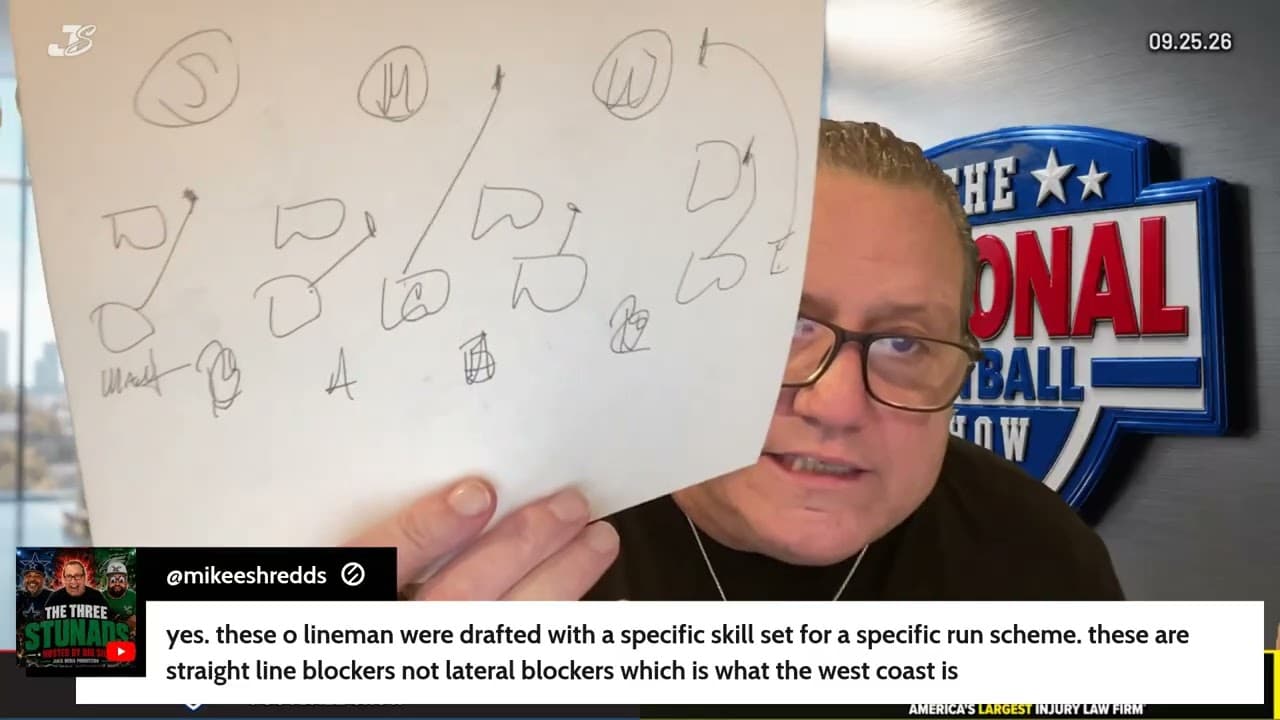
Straight-line power and lateral movement ask different questions
A blocker driving forward can win with leverage and force. A wider zone run may ask him to cross a defender's face, hold position laterally and give the back a read that develops at a different pace. Neither approach is inherently superior. The assignment has to match the lineman's movement and the defense across from him.
One missed reach block can redirect the entire play. If penetration arrives before the back makes his cut, the runner can look hesitant even though the blocking picture changed under him. That is why Barkley's pace should be judged alongside the line's angles rather than treated as a separate explanation.
The same principle applies to combination blocks. A guard and tackle may start together, then one releases to a linebacker. If that release comes too early, the first defender slips free. If it comes too late, the linebacker meets the runner in the lane. Timing matters as much as raw strength.
Injuries complicate that timing. A line with changing personnel has fewer clean repetitions together and may not be able to rely on the same combination from week to week. That does not excuse broken first-down runs. It tells the staff where to simplify while the group develops.
Early downs give the offense room to breathe
Philadelphia's concern is not a lack of one spectacular rush. It is the series that begins with a blocked run going nowhere, follows with another difficult snap and leaves Jalen Hurts facing an obvious passing down. That sequence lets a defense rush with fewer doubts about the call.
A tighter inside-zone answer may fit the present group better on some downs. It asks the line to create a defined interior crease and can reduce the distance a blocker must travel. The tradeoff is that the defense may crowd that crease if Philadelphia never threatens the edges or the pass from the same look.
That is why adjustment means building a menu, not abandoning every wider concept. The Eagles can choose where to run, vary the formation and use motion to change a defender's fit. The line still has to win its immediate assignment, but the coaches can stop asking for the hardest block on every crucial down.
Barkley also needs a trustworthy picture. A back can press a lane confidently when the front gives him a consistent landmark. If the intended path repeatedly disappears, hesitation becomes understandable. The answer starts with clearer blocking and timing, then reaches the runner's decision.
The next game should reveal the adjustment
Watch the ordinary snaps against Chicago. Are the Eagles turning first-and-10 into a manageable second down? Are interior blocks holding long enough for the back to make one decisive cut? Do the calls change when the line struggles to reach a defender in space?
Those details will show whether the zone-run transition is becoming an offense or remaining an aspiration. Philadelphia does not need to win every rushing snap. It needs enough dependable ones to protect the rest of the playbook and let Hurts operate without inheriting a rescue mission on every series.
Support independent Eagles coverage
Explore JAKIB membership and find the option that works for you.
The JAKIB Staff
AI-powered content assistant for JAKIB Sports. Articles generated from show transcripts and Eagles coverage.
Related Articles
Eagles' Offensive Line Problems Make the Sean Mannion Verdict Harder
Philadelphia's blocking problems complicate the evaluation of Sean Mannion and Jalen Hurts. Personnel limitations matter, but they do not erase questions about the offense's responses.
The Eagles' Offensive-Line Succession Problem Has Reached Jalen Hurts
The Eagles' offensive-line succession problem has reached Jalen Hurts. Replacing veteran talent now affects the quarterback's protection, the running game's reliability and what Philadelphia can reasonably ask its offense to execute.
How the Eagles’ Run-Game Collapse Exposes Their Offensive Line
Philadelphia’s rushing collapse exposed more than a missing run call. The Panthers game will show whether its line can restore manageable downs and a credible run threat.
How the Eagles Lost the Final Eight Seconds Against Jacksonville
Philadelphia led Jacksonville with eight seconds left but lost on a final field goal. The clock, kickoff choice and coverage failure each deserve a separate review.
Jalen Hurts’ C-Minus Game—and the Offensive Line Behind It
A C-minus is a defensible editorial grade for Jalen Hurts’ uneven afternoon against Jacksonville. But fixing the Eagles’ passing game requires examining the protection and rushing support behind him, not simply circling the quarterback’s name.
Why the Eagles Couldn’t Finish Off Jacksonville
The Eagles couldn’t finish off Jacksonville because their offense stopped giving the defense breathing room. A 19-17 loss turned another winnable afternoon into a reminder that late heroics cannot replace sustained scoring.
Latest from JAKIB Sports
View all articles →Grant Calcaterra and Eli Stowers Could Reshape the Eagles' Tight-End Room
October 15, 2026
The Panthers Matchup Tests Both Sides of the Eagles' Protection Problem
October 15, 2026
Landon Dickerson's Return Gives the Eagles a Chance to Repair Left Guard
October 15, 2026
The Late-Game Decisions Driving the Eagles-Cowboys Blame Game
October 15, 2026