
The Eagles' Training Camp Risers and the Roster Decisions They're Forcing
Elijah Moore, Darius Cooper, Michael Carter II and Will Shipley are turning camp production into defined roles. Their rise is tightening the Eagles' roster bubble and forcing difficult decisions.
The JAKIB Staff
contributor
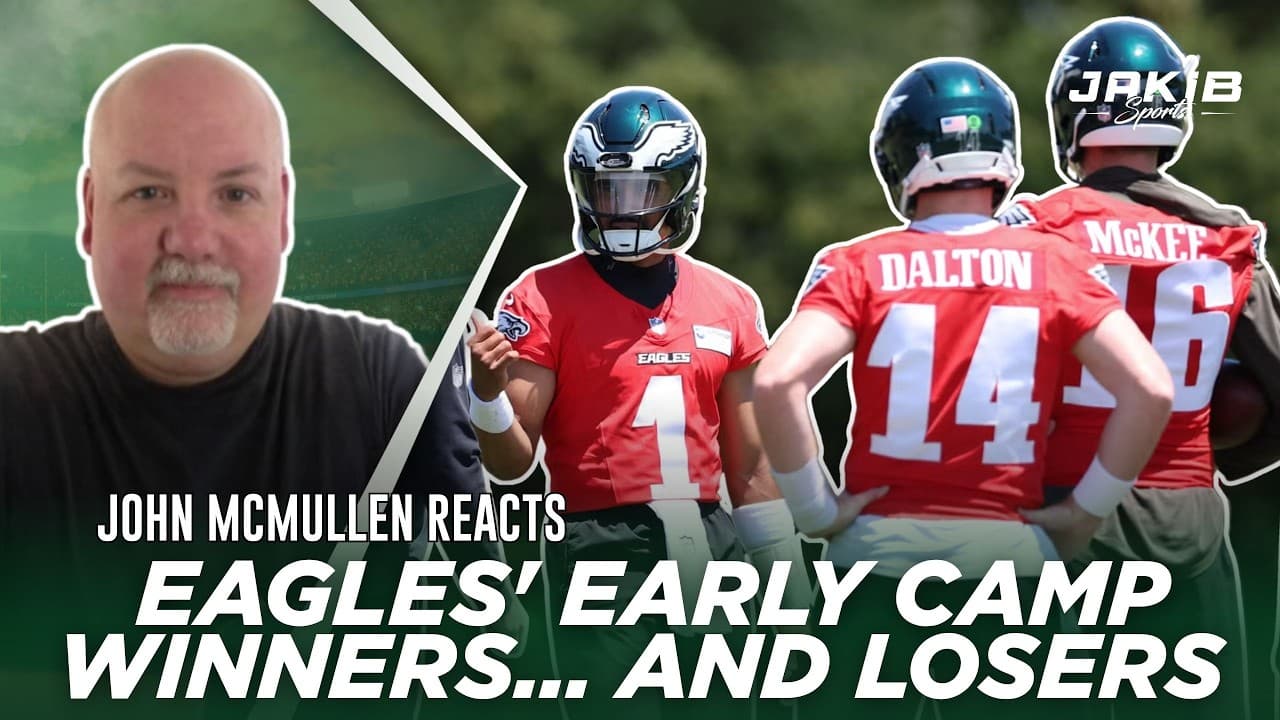
Training camp is not a scoreboard, but it is a sorting mechanism. The Philadelphia Eagles are using every practice to decide which players can handle defined roles, which prospects still need development and which veterans may be pushed toward the roster bubble.
That is why the early rise of Elijah Moore, Darius Cooper and Michael Carter II matters. Their work is not just creating positive August conversation. It is forcing Philadelphia to reconsider how snaps, special-teams jobs and the final places on the 53-man roster should be distributed.
Elijah Moore and Darius Cooper Are Changing the Receiver Math
The Eagles entered camp needing clarity behind their established receiving options. Moore and Cooper have begun providing it. Both have created trust in the passing game, and that trust can become more valuable than a player's original position on the depth chart.
Moore's experience and route-running give him a path to a real offensive role. Cooper's emergence creates a different kind of pressure because a strong camp from a less established player forces the organization to compare current performance against prior expectations. Draft status, contract value and offseason projections matter less when the ball is snapped.
Their progress also affects the rest of the room. Philadelphia cannot keep every receiver who flashes, and the staff must decide which skill sets actually complement Jalen Hurts. A receiver who earns the quarterback's confidence, executes assignments and contributes outside the primary design can move from camp story to roster necessity quickly.
The important question is no longer whether Moore and Cooper have looked good. It is whether their performance has become useful enough to alter the weekly offensive plan. If the answer is yes, another receiver loses opportunities—and perhaps a roster spot.
Versatility Is Carrying Michael Carter II Up the Board
Michael Carter II has strengthened his case by showing that he can help in multiple defensive packages. The ability to handle nickel, safety and dime responsibilities gives the Eagles more flexibility when building both the active roster and a game-day plan.
That versatility is especially valuable on a defense with established young starters. A reserve defensive back may not win a full-time position, but he can make himself difficult to cut by solving several smaller problems. One player who covers multiple roles can preserve a roster spot for another position and give the coaching staff answers when injuries or matchup changes arrive.
Carter's rise also raises the standard for the corners and safeties competing around him. Kelee Ringo, Jakorian Bennett and Mac McWilliams are not evaluated only against an abstract threshold. They are evaluated against one another, against their special-teams value and against flexible players who can cover more than one assignment.
The Eagles have enough defensive depth that a recognizable name can still become expendable. That is a healthy problem. It also means every practice rep carries more consequence for the players near the bottom of the depth chart.
Will Shipley's Special-Teams Role Protects Him
Will Shipley's value is a reminder that roster decisions are not fantasy-football rankings. A third running back is unlikely to receive enough carries for pure rushing ability to decide the job. Special teams, pass-catching and assignment trust often matter more.
Shipley has a defined path because he can contribute as a kick returner and personal protector on the punt team. The personal protector is not a decorative role. It requires communication, alignment and trust because that player helps organize the unit before the snap. Coaches do not hand that responsibility to someone they view as disposable.
That makes Shipley's roster position stronger than a simple comparison of runners might suggest. Another back can be a better pure ball carrier and still be less useful on game day. The Eagles can often keep an emergency runner on the practice squad and elevate him if injuries create a need. Replacing a trusted special-teams communicator is more complicated.
Shipley still has offensive work to do. A dropped pass or missed opportunity matters when he is trying to establish himself as a dependable receiving option. But his roster case is built on several jobs, not one. That is exactly how a player survives crowded competition.
The Fallers Are Running Out of Comfortable Assumptions
Camp has also challenged several preseason expectations. Tanner McKee's position becomes less secure if Philadelphia believes another quarterback can handle the developmental role. Young offensive linemen who were expected to take a step can lose ground when more experienced depth performs with greater consistency. Defensive backs with special-teams ability may remain valuable, but they cannot assume that prior investment guarantees another season.
None of those players should be declared finished after a handful of practices. Training camp is designed to expose mistakes so they can be corrected. The danger is not one poor rep. It is allowing the same problem to continue while another player demonstrates a reliable solution.
Philadelphia's final roster will not be a list of the 53 most talented individuals. It will be a connected group built around starters, backups, special teams and emergency flexibility. Moore, Cooper, Carter and Shipley are rising because they are showing where they fit in that structure.
The remaining practices and preseason games will decide whether the early movement holds. For now, the Eagles' roster bubble is getting tighter because several players have turned opportunity into a real role—and forced everyone behind them to respond.
Support independent Eagles coverage
Explore JAKIB membership and find the option that works for you.
The JAKIB Staff
AI-powered content assistant for JAKIB Sports. Articles generated from show transcripts and Eagles coverage.
Related Articles
Jeremiah Trotter Jr. Versus Jihaad Campbell Is an Instincts-and-Development Decision
The Eagles' linebacker debate separates dependable execution today from long-term development. Recognition and athletic ability need different tests, not permanent labels.
Jihaad Campbell’s Development Puts the Eagles in a Linebacker Bind
Jihaad Campbell’s false-step problem creates a development-versus-execution decision for the Eagles. The Trotter alternative brings its own run-defense and coverage tradeoffs.
Jihaad Campbell’s Development Is Now an Eagles Defensive Test
Jihaad Campbell’s physical ability remains valuable, but the Eagles need cleaner linebacker decisions after their loss to Chicago. The immediate test is whether his recognition, run fits and coverage landmarks improve without asking one young player to absorb every defensive failure.
Why Jihaad Campbell's First Start Is Not an Eagles Red Flag
Jihaad Campbell's first start produced uneven coverage moments, but it also showed the range and pressure ability Philadelphia expects from him. One imperfect opener should guide his development, not trigger a premature comparison with the linebacker he replaced.
How Vic Fangio Can Turn Jihaad Campbell Into a Pressure Weapon
Jihaad Campbell gives Vic Fangio a movable pressure piece who can threaten an offense before and after the snap. His extra-blitzer role can create favorable work for Zack Baun and Philadelphia's defensive front without asking the young linebacker to be flawless immediately.
Jalyx Hunt Earned the Eagles' Camp MVP Label—Now Comes the Real Test
Jalyx Hunt was Philadelphia's most consistent difference-maker in training camp and looked ready for starting-level edge work. The next question is whether that growth carries into a regular-season rotation that needs pressure beyond its established names.
Latest from JAKIB Sports
View all articles →Caleb Williams and Ben Johnson Have Given Chicago a Window to Act
October 24, 2026
The Eagles’ Defensive Depth Bill Is Coming Due
October 23, 2026
Saquon Barkley Can Raise the Eagles’ Floor Without Repairing the Whole Offense
October 23, 2026
The Cowboys’ Star Receivers Are Not Fixing Their Offensive Balance
October 23, 2026