
Why the Eagles' Offensive Transition Is About More Than Training Camp Mistakes
The Eagles can correct ordinary installation errors with repetition. Lane Johnson's absence and the unsettled post-A.J. Brown receiver room create deeper questions for Sean Mannion's new offense.
The JAKIB Staff
contributor
The Eagles' early offensive problems are not one simple training camp story. Some mistakes belong to installation. Others expose deeper questions about personnel, continuity, and how much change Philadelphia can absorb at once. The difference matters because only one category is guaranteed to improve with repetition.
Sean Mannion is installing a new offense with different language, formations, and teaching points. Jalen Hurts and the rest of the unit should look imperfect in August. But Lane Johnson's extended absence and the uncertainty behind DeVonta Smith at receiver are not terminology errors. They affect the quality of every rep and the ceiling of the finished product.
Installation Mistakes Should Be Fixable
New systems create hesitation. Players have to translate calls, recognize assignments, and execute at full speed before those details become automatic. Pre-snap penalties, alignment errors, and route-spacing mistakes are frustrating, but camp is designed to reveal them.
The standard is improvement. If the same procedural errors continue after repeated correction, the problem shifts from normal learning to poor operation. Mannion and Nick Sirianni must determine which details require more teaching, which concepts need simplification, and which players are not executing reliably.
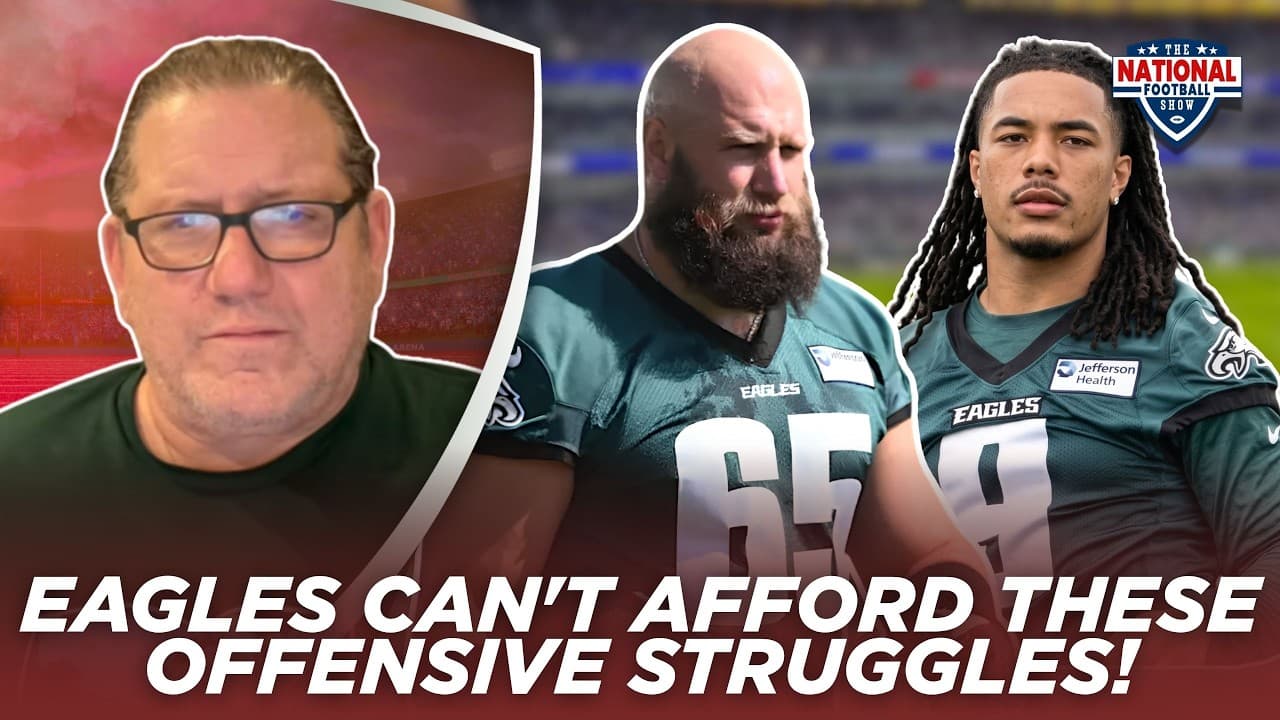
Philadelphia should not judge the scheme solely by whether Vic Fangio's defense wins a practice. Fangio has a deep, disciplined unit capable of punishing uncertainty. Losing a rep to good coverage can teach the offense something valuable. Losing before the snap teaches only that the foundation is not clean enough yet.
Lane Johnson's Absence Changes the Environment
Johnson does not need camp reps to prove his individual ability. His fourth consecutive non-injury absence still matters because the offensive line is learning different details without its most accomplished veteran on the field.
The Eagles can use the work to evaluate backups, and that depth information has real value. It does not replace first-team continuity. Johnson's presence stabilizes protection, communication, and the right side of the run game. When he returns, some of the current stress should ease. Until then, the offense is trying to install change without one of the players best equipped to make change manageable.
That is a personnel and continuity issue, not merely a camp mistake. Philadelphia should remain patient and avoid unsupported conclusions about the reason for Johnson's absence. It should also acknowledge that the new offense is receiving an incomplete test without him.
The Receiver Room Has Less Margin
The post-A.J. Brown receiver room creates the other structural concern. Smith is an established difference-maker, but the offense needs credible answers around him. Makai Lemon's missed time limits a rookie's opportunity to build timing and challenge for a major role. Dontayvion Wicks, Darius Cooper, Elijah Moore, and the rest of the group have to prove they can create a dependable rotation.
This matters to Hurts' evaluation. A quarterback can make the correct decision and still produce an ugly result if the receiver runs the wrong route or fails to separate. Camp statistics without assignment context can mislead. At the same time, Philadelphia cannot use a developing receiver room as a permanent excuse. Somebody has to emerge.
Mannion must help through design. Motion, formation variation, play action, and the quarterback-run threat can create leverage that reduces the burden on individual receivers. The offense no longer has the luxury of expecting one dominant outside player to rescue every difficult down.
The Real Test Is Whether the Problems Shrink
There is no reason to declare the offensive transition a failure after a handful of practices. There is also no value in labeling every issue normal installation noise.
The Eagles need Johnson back, a clearer receiver hierarchy, and cleaner daily operation. Those developments would allow coaches to evaluate whether the scheme fits Hurts and the rest of the roster. If penalties and assignment errors fall while Wicks, Lemon, Cooper, or Moore supplies a reliable answer, the early turbulence will look productive.
If the same mistakes remain and the personnel questions deepen, the concern will be larger than August sloppiness. Philadelphia is not merely learning new plays. It is testing whether a changed offense can preserve the strengths of a roster with less proven receiving firepower and temporary instability at right tackle.
Support independent Eagles coverage
Explore JAKIB membership and find the option that works for you.
The JAKIB Staff
AI-powered content assistant for JAKIB Sports. Articles generated from show transcripts and Eagles coverage.
Related Articles
The Cowboys’ Star Receivers Are Not Fixing Their Offensive Balance
Dallas’ star receivers cannot supply balance by themselves. Early run abandonment can leave the protection exposed and give Philadelphia a clearer choice about how to attack.
Johnny Mundt’s Blocking Role Is Smaller Than the Eagles’ Offensive Demand
Johnny Mundt can have value in a defined movement role. Philadelphia’s broader tight-end demands require a closer look at assignments and workload, rather than a universal blocking label.
The Eagles’ Next Offensive Plan Needs a Builder, Not a Copy
Sean Mannion’s next offensive plan should connect the quarterback’s reads, receiving roles and protection timing. A useful role for Makai Lemon and a dependable core of calls would give Philadelphia a foundation to develop.
Eagles' Offensive Line Problems Make the Sean Mannion Verdict Harder
Philadelphia's blocking problems complicate the evaluation of Sean Mannion and Jalen Hurts. Personnel limitations matter, but they do not erase questions about the offense's responses.
The Eagles' Offensive-Line Succession Problem Has Reached Jalen Hurts
The Eagles' offensive-line succession problem has reached Jalen Hurts. Replacing veteran talent now affects the quarterback's protection, the running game's reliability and what Philadelphia can reasonably ask its offense to execute.
How the Eagles’ Run-Game Collapse Exposes Their Offensive Line
Philadelphia’s rushing collapse exposed more than a missing run call. The Panthers game will show whether its line can restore manageable downs and a credible run threat.
Latest from JAKIB Sports
View all articles →Jeffrey Lurie’s Honor Arrives Amid an Eagles Trust Problem
October 26, 2026
The Eagles’ Film Meeting Changes the Room, Not the Personnel
October 26, 2026
DeVonta Smith’s Rest Question Is About Weeks, Not the Season
October 26, 2026
Caleb Williams and Ben Johnson Have Given Chicago a Window to Act
October 24, 2026