
Why the Eagles' Offensive Struggles Need More Context Than Camp Stats Show
Training camp results matter, but unofficial practice scores miss the real evaluation. The Eagles need fewer repeated mistakes as Sean Mannion's changing offense gets healthier and more settled.
The JAKIB Staff
contributor
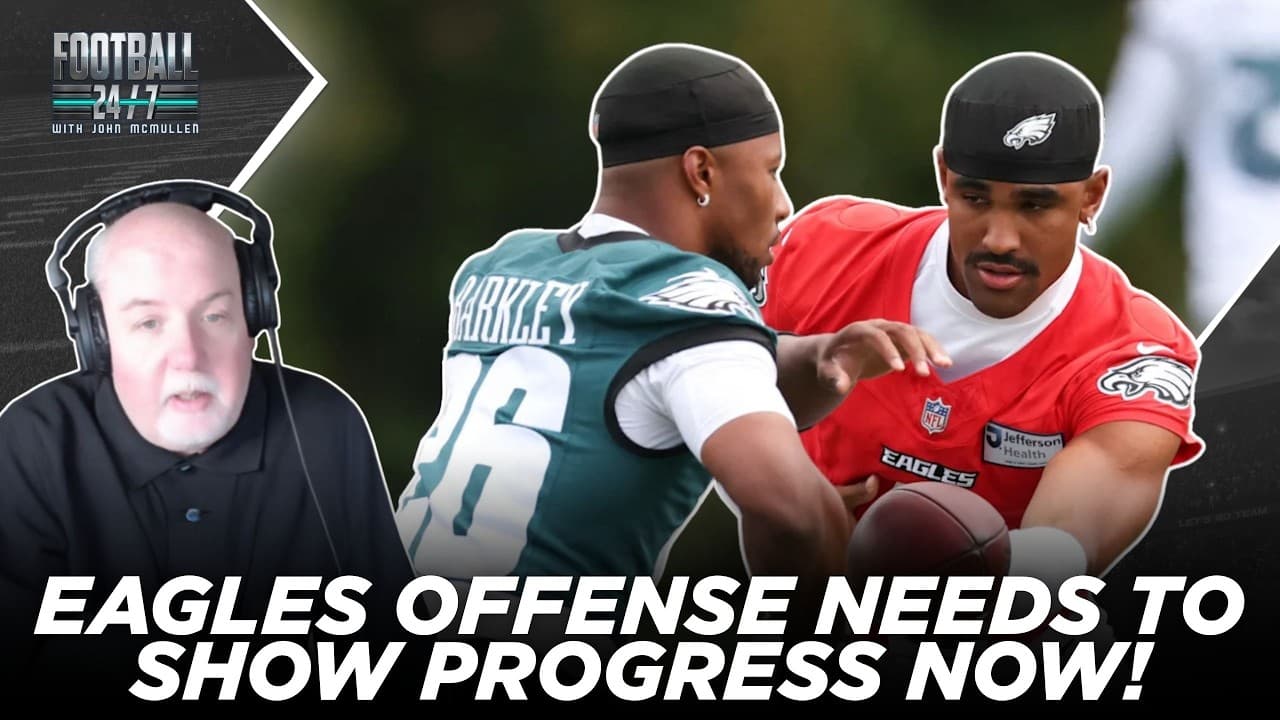
The Philadelphia Eagles' offensive struggles through six training camp practices deserve attention, but not a fake scoreboard. A defense "winning" a practice does not tell us whether Sean Mannion's offense is ready for September. The useful question is whether mistakes are being corrected while a changing lineup learns a different structure.
That distinction matters because Philadelphia is installing more than a few new calls. The offense is working through more under-center snaps, motion, misdirection and a progression-based passing approach. At the same time, important players including Lane Johnson, DeVonta Smith, Makai Lemon and Landon Dickerson have missed reps. Judging the entire unit from raw completions, interceptions or one uneven period strips away the context that makes camp evaluation meaningful.
Practice Stats Do Not Measure the Real Work
Training camp is not a game, and treating it like one creates bad conclusions. The offense can lose a competitive period while a receiver improves his route depth, a lineman handles a new assignment correctly or Jalen Hurts reaches the proper answer against a disguised coverage. Those details matter more than an unofficial daily score.
The opposite is also true. A clean completion does not automatically prove the offense is improving if it came from a busted coverage or if another player missed an assignment. Practice is valuable because coaches can isolate the process behind the result. Fans usually see the result first.
That is why box-score language fails here. The Eagles are testing concepts, evaluating players and teaching a system while their own defense presents one of the hardest daily examinations available. Philadelphia should want the offense challenged now. Easy August wins would provide less useful information than difficult reps that expose problems early enough to fix them.
Missing Starters Change Every Rep
The lineup has not been stable. Johnson's absence changes protection and the standard at right tackle. Dickerson's missed work alters the interior combination. Smith's absence removes the passing game's most established receiver, while Lemon's missed reps take a first-round rookie out of an important developmental window.
Lemon is especially relevant because the Eagles traded up to select him 20th overall. That investment does not guarantee an immediate role, but it makes every practice rep valuable. A young receiver needs repetition to connect route timing, formation rules and quarterback expectations. When Lemon and Smith are unavailable, the remaining receivers gain opportunity, but the first-team offense is no longer being evaluated with the group Philadelphia expects to carry into the season.
None of that excuses sloppy football. It explains why a rough day with several missing pieces should not be treated as a final verdict. The responsible evaluation separates errors caused by temporary lineup disruption from errors that keep returning regardless of personnel.
Sean Mannion's Changes Need Time, Not Immunity
Mannion is in his first season as the Eagles' offensive coordinator and is taking on the job after two years on Green Bay's coaching staff. The installation asks the offense to operate differently, including more pure progression reads in which the quarterback works through eligible targets in sequence instead of making every decision from a pre-snap coverage diagnosis.
That approach can help the offense play faster, but only after the details become automatic. More under-center work changes footwork and timing. Motion and misdirection demand clean communication. A new progression structure requires every route to arrive where the quarterback expects it. One player's hesitation can disrupt the entire play.
Camp gives Mannion room to teach those changes, yet limited practice time raises the standard for each session. The Eagles cannot simply wait for the system to click. They need evidence that a mistake identified on one day is less likely to appear on the next.
Incremental Improvement Is the Standard
Progress will not be a straight line. One practice can look cleaner, the next can expose a new weakness, and the overall trend can still move forward. The evaluation should focus on higher-quality decisions, fewer repeated procedural errors, sharper timing and better execution when the personnel becomes more complete.
That is the middle ground the Eagles need. Six practices are not enough to declare the offense broken. They are also too valuable to dismiss because the calendar says August. Practice results matter when they reveal whether Philadelphia is learning.
The next stretch should provide a clearer picture as players return and the installation advances. If the same mistakes survive better health and more repetition, concern becomes justified. If the offense grows cleaner while Mannion's progression-based structure takes hold, the ugly early periods will have served their purpose.
Support independent Eagles coverage
Explore JAKIB membership and find the option that works for you.
The JAKIB Staff
AI-powered content assistant for JAKIB Sports. Articles generated from show transcripts and Eagles coverage.
Related Articles
The Cowboys’ Star Receivers Are Not Fixing Their Offensive Balance
Dallas’ star receivers cannot supply balance by themselves. Early run abandonment can leave the protection exposed and give Philadelphia a clearer choice about how to attack.
Johnny Mundt’s Blocking Role Is Smaller Than the Eagles’ Offensive Demand
Johnny Mundt can have value in a defined movement role. Philadelphia’s broader tight-end demands require a closer look at assignments and workload, rather than a universal blocking label.
The Eagles’ Next Offensive Plan Needs a Builder, Not a Copy
Sean Mannion’s next offensive plan should connect the quarterback’s reads, receiving roles and protection timing. A useful role for Makai Lemon and a dependable core of calls would give Philadelphia a foundation to develop.
Eagles' Offensive Line Problems Make the Sean Mannion Verdict Harder
Philadelphia's blocking problems complicate the evaluation of Sean Mannion and Jalen Hurts. Personnel limitations matter, but they do not erase questions about the offense's responses.
The Eagles' Offensive-Line Succession Problem Has Reached Jalen Hurts
The Eagles' offensive-line succession problem has reached Jalen Hurts. Replacing veteran talent now affects the quarterback's protection, the running game's reliability and what Philadelphia can reasonably ask its offense to execute.
How the Eagles’ Run-Game Collapse Exposes Their Offensive Line
Philadelphia’s rushing collapse exposed more than a missing run call. The Panthers game will show whether its line can restore manageable downs and a credible run threat.
Latest from JAKIB Sports
View all articles →Jeffrey Lurie’s Honor Arrives Amid an Eagles Trust Problem
October 26, 2026
The Eagles’ Film Meeting Changes the Room, Not the Personnel
October 26, 2026
DeVonta Smith’s Rest Question Is About Weeks, Not the Season
October 26, 2026
Caleb Williams and Ben Johnson Have Given Chicago a Window to Act
October 24, 2026