
Lane Johnson's Hall of Fame Case Is Stronger Than His Awards Suggest
Lane Johnson's résumé is impressive, but his strongest Hall of Fame argument is the way Philadelphia's offense changes when he is absent. The Eagles' record split and his value in decisive situations reveal impact that honors alone cannot capture.
The JAKIB Staff
contributor
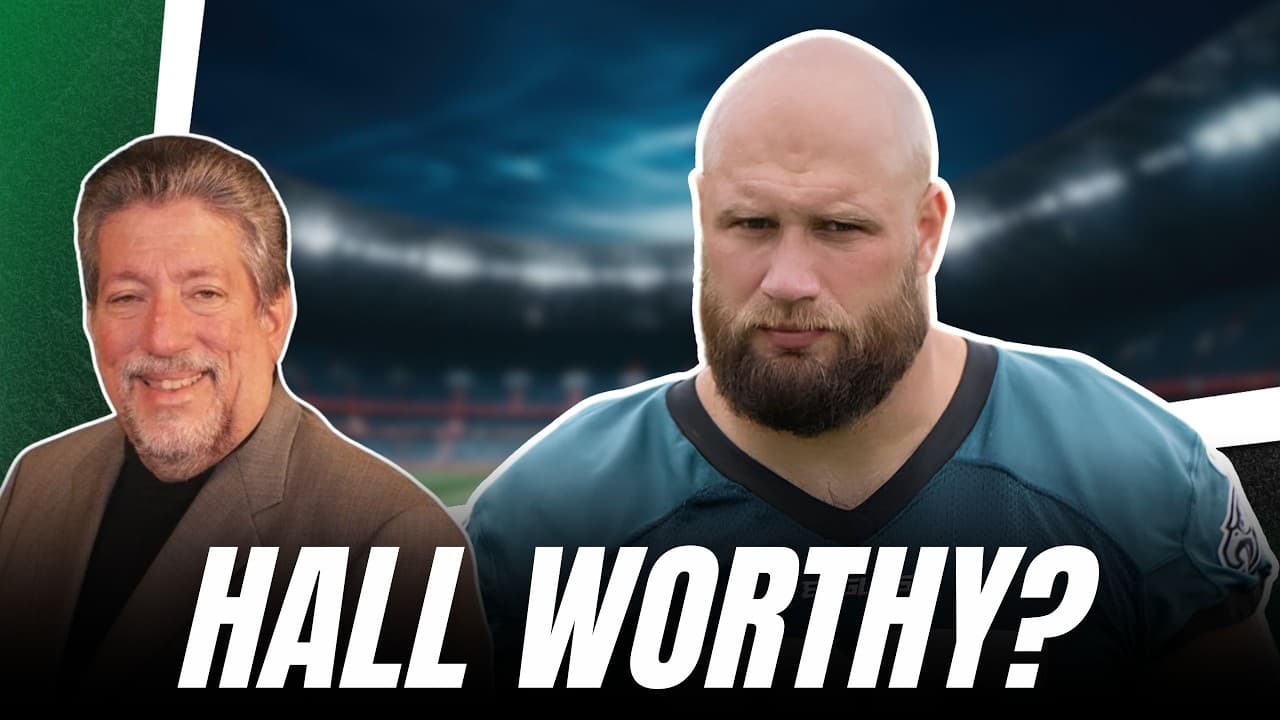
Lane Johnson's Pro Football Hall of Fame case should not be reduced to a count of awards. His honors establish that he belonged among the elite tackles of his era. The Philadelphia Eagles' performance with and without him shows why that excellence changed the possibilities of an entire offense.
The record presented during the National Football Show discussion is striking: Philadelphia stood 110-57-1 with Johnson available and 18-27 without him. No tackle owns every result in a team sport, and the split should not be treated as a one-player statistic. It still captures how often the Eagles' structure weakened when its right-side anchor disappeared.
Offensive tackle impact hides inside other numbers
Great line play is easiest to notice after it disappears. A clean edge gives the quarterback time to reach a second read. Secure movement in the run game lets the offense stay on schedule. Protection on third down keeps a drive alive, but the box score usually credits the passer, receiver or runner who finishes the play.
Johnson has delivered those hidden advantages for years. His athleticism allows Philadelphia to use movement concepts that many tackles cannot execute. His balance in pass protection lets the offense help somewhere else rather than constantly sending a tight end or back to his side.
That freedom changes play calling. It expands the menu on important downs and protects the offense from becoming predictable. When Johnson is unavailable, the replacement is not merely asked to survive one matchup. The entire operation may have to devote extra bodies, alter route timing and limit the quarterback's margin for error.
The Eagles' record split supplies rare context
Win-loss records are usually a blunt tool for evaluating non-quarterbacks. Johnson's split matters because it is unusually large and fits the football evidence. Philadelphia has often looked less stable on third down, in the red zone and late in games when protection problems force the offense away from its preferred answers.
Those situations define postseason football. Defenses become more specific, obvious passing downs become more dangerous and one lost edge can end a season. Johnson's reliability has allowed the Eagles to preserve their identity against the league's best fronts.
The case does not require claiming he produced every victory. It asks voters to recognize that elite tackle play affects every skill player around it. Quarterbacks hold the ball with more confidence. Running backs see cleaner tracks. Coordinators call deeper concepts because they trust the protection.
Hall of Fame evaluation should include functional dominance
Awards matter because they compare a player to his peers. They can also miss the full value of positions that do not generate easy counting statistics. A Hall of Fame tackle should combine longevity, peak performance and a clear effect on winning football. Johnson's case reaches all three categories.
His career has also unfolded inside an Eagles organization that treats the line of scrimmage as a competitive advantage. That context should not diminish him. Philadelphia's investment created a demanding standard, and Johnson became the player who made the standard work at its highest level.
The strongest argument is visible when the Eagles face a defense capable of wrecking a game. Johnson does not need constant help, which allows the rest of the protection to address pressure elsewhere. That is functional dominance: one player removing a major problem before the ball is snapped.
The final résumé is bigger than a trophy count
Hall of Fame voters eventually have to compare Johnson with other great linemen and candidates from every position. His awards will begin the discussion. His film, longevity and the offense's dramatic change without him should carry it further.
Philadelphia's 110-57-1 mark with Johnson is not a magic proof. It is evidence that supports what years of high-level tape already show. The Eagles have been more complete, more flexible and more dependable because their right tackle could handle assignments that reshape an offense.
That influence deserves to be treated as more than supporting work. Johnson has been one of the central reasons Philadelphia could build through the trenches and expect the plan to hold against elite competition. His Hall of Fame case is strong because the awards describe his reputation, while the Eagles' results reveal his consequence.
Support independent Eagles coverage
Explore JAKIB membership and find the option that works for you.
The JAKIB Staff
AI-powered content assistant for JAKIB Sports. Articles generated from show transcripts and Eagles coverage.
Related Articles
The Cowboys’ Star Receivers Are Not Fixing Their Offensive Balance
Dallas’ star receivers cannot supply balance by themselves. Early run abandonment can leave the protection exposed and give Philadelphia a clearer choice about how to attack.
Evan Neal’s Eagles Opportunity Starts With Guard Fundamentals
Evan Neal’s practice-squad signing gives Philadelphia an interior-line development option. His next opportunity depends on repeatable guard technique, rather than his old draft position.
Johnny Mundt’s Blocking Role Is Smaller Than the Eagles’ Offensive Demand
Johnny Mundt can have value in a defined movement role. Philadelphia’s broader tight-end demands require a closer look at assignments and workload, rather than a universal blocking label.
The Eagles’ Coaching Verdict Cannot Ignore the Roster
The Eagles’ coaching evaluation has to account for roster limitations without letting them excuse every failure. Protection assignments and the staff’s adjustments offer a more useful test than a blanket verdict.
Tanner McKee’s Dallas Test Starts Over the Middle
Quick middle-field routes offer Tanner McKee a practical test against Dallas. The Eagles need timing, protection and receiving options that make an early throw productive.
The Eagles’ Line Rebuild Has Two Different Clocks
The Eagles can pursue a faster interior rebuild while treating tackle succession as a separate problem. That distinction changes how they should spend picks and evaluate veterans.
Latest from JAKIB Sports
View all articles →Jeffrey Lurie’s Honor Arrives Amid an Eagles Trust Problem
October 26, 2026
The Eagles’ Film Meeting Changes the Room, Not the Personnel
October 26, 2026
DeVonta Smith’s Rest Question Is About Weeks, Not the Season
October 26, 2026
Caleb Williams and Ben Johnson Have Given Chicago a Window to Act
October 24, 2026