
Lane Johnson's Absence Has Opened a Critical Opportunity for Markel Bell
Lane Johnson's absence has turned Markel Bell's first-team work into a major test of Philadelphia's swing-tackle depth and Chris Kuper's development plan.
The JAKIB Staff
contributor
Lane Johnson's absence is not only a problem for the Philadelphia Eagles. It is the first serious development test for Markel Bell and offensive line coach Chris Kuper.
Every first-team rep Bell receives carries more weight because the Eagles cannot treat right tackle as an ordinary depth position. Johnson has defined the standard there for years. Philadelphia now has to prepare for the day he is unavailable without pretending one young lineman can immediately reproduce everything he does.
First-Team Reps Create a Real Evaluation
Training-camp rotation can be noisy, but snaps with the starting offense reveal more than isolated drills. Bell has to communicate protections, handle the speed of the rush and maintain the timing of an offense that expects the pocket to stay organized.
The Eagles need to learn whether his tools translate when the assignment changes after the snap. Size and movement ability matter, but a swing tackle survives through recognition, balance and consistency. One missed adjustment can disrupt the quarterback before the route concept develops.
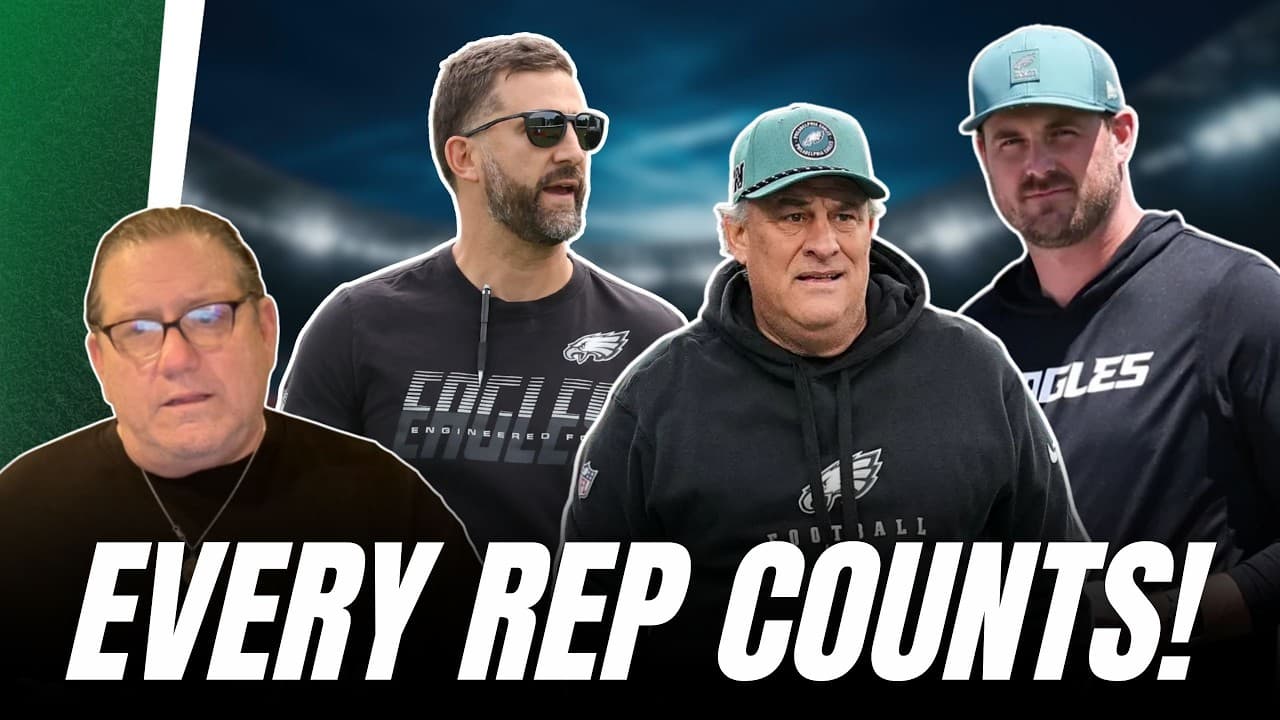
That is why Johnson's absence creates opportunity rather than a ceremonial promotion. Bell is receiving the kind of work that can move him from a developmental prospect into a player the coaching staff is willing to activate and trust.
Chris Kuper Has to Accelerate the Development
Kuper's first major challenge is not redesigning Johnson. It is building a usable tackle behind him.
That requires a clear plan. Bell needs technical priorities he can repeat: a dependable set point, disciplined hands and an understanding of when to stay square rather than chase an edge rusher. The coaching staff also has to identify which protections and run concepts allow him to play fast.
Development is not the same as hiding a player. Philadelphia can give Bell help with formations, chips and protection calls, but the offense cannot become limited every time the backup enters. Kuper's job is to raise Bell's floor while testing whether his ceiling is high enough to justify more responsibility.
The early camp work provides immediate feedback. If Bell handles starting-level speed, the Eagles gain flexibility. If he struggles with the same mistake repeatedly, the front office receives an equally useful answer before the season forces the issue.
Swing Tackle Depth Shapes the Entire Line
A trustworthy swing tackle protects more than one position. He allows the Eagles to avoid moving multiple starters when an injury occurs and keeps the interior combinations intact.
Fred Johnson gives Philadelphia an experienced option, but the best version of the depth chart includes another tackle who can enter without changing the offense's identity. Bell's emergence would create competition and reduce the pressure on one veteran reserve to cover every emergency.
It would also give the Eagles choices on game day. A developmental tackle who can contribute in heavy packages, handle spot duty and continue growing is more valuable than a player who can only practice at one position.
Bell Does Not Have to Be Lane Johnson
The comparison can become unfair if every Bell rep is measured against an All-Pro standard. Philadelphia does not need a duplicate. It needs a reserve whose technique, communication and physical ability keep the offense functional.
Johnson's absence raises the urgency because the transition can no longer remain a future conversation. Bell is receiving the evidence-producing snaps now. Kuper is getting his first chance to show that the Eagles' offensive line pipeline can develop the next answer rather than rely only on established stars.
The opportunity is critical because it affects both the present and the succession plan. If Bell proves he can hold up, Philadelphia gains affordable depth at a premium position. If he cannot, the Eagles still have time to adjust.
Camp is the scoreboard. For Bell, these first-team reps may be the most important points on it.
Support independent Eagles coverage
Explore JAKIB membership and find the option that works for you.
The JAKIB Staff
AI-powered content assistant for JAKIB Sports. Articles generated from show transcripts and Eagles coverage.
Related Articles
The Cowboys’ Star Receivers Are Not Fixing Their Offensive Balance
Dallas’ star receivers cannot supply balance by themselves. Early run abandonment can leave the protection exposed and give Philadelphia a clearer choice about how to attack.
Evan Neal’s Eagles Opportunity Starts With Guard Fundamentals
Evan Neal’s practice-squad signing gives Philadelphia an interior-line development option. His next opportunity depends on repeatable guard technique, rather than his old draft position.
Johnny Mundt’s Blocking Role Is Smaller Than the Eagles’ Offensive Demand
Johnny Mundt can have value in a defined movement role. Philadelphia’s broader tight-end demands require a closer look at assignments and workload, rather than a universal blocking label.
The Eagles’ Coaching Verdict Cannot Ignore the Roster
The Eagles’ coaching evaluation has to account for roster limitations without letting them excuse every failure. Protection assignments and the staff’s adjustments offer a more useful test than a blanket verdict.
Tanner McKee’s Dallas Test Starts Over the Middle
Quick middle-field routes offer Tanner McKee a practical test against Dallas. The Eagles need timing, protection and receiving options that make an early throw productive.
The Eagles’ Line Rebuild Has Two Different Clocks
The Eagles can pursue a faster interior rebuild while treating tackle succession as a separate problem. That distinction changes how they should spend picks and evaluate veterans.