
Four Games Could Decide Howie Roseman's Trade-Deadline Approach
Four games could decide how Howie Roseman approaches the trade deadline. The Eagles' next stretch should clarify whether a valuable offer serves a realistic playoff push or a roster that needs a faster reset.
The JAKIB Staff
contributor
Four games could decide how Howie Roseman approaches the trade deadline. The Eagles' next stretch should clarify whether a valuable offer serves a realistic playoff push or a roster that needs a faster reset.
That is a conditional choice, not a report that Philadelphia has started shopping specific players. A 2-3 record after three straight losses makes the question fair. It does not make every veteran expendable.
The distinction matters because Roseman has already demonstrated that a trade can address several goals. Moving a player for meaningful value is different from selling simply to look decisive after a bad Sunday.
The Jurgens deal supplies a standard for value
The Eagles officially traded Cam Jurgens to Baltimore along with a 2027 seventh-round pick. Philadelphia received a 2027 fifth-round selection and a 2028 second-round selection. Those terms, detailed in the team's coverage, are concrete evidence of the return Roseman accepted.
Roseman also told the team's reporters that the Eagles had not been looking to move Jurgens. His explanation combined the available draft compensation, financial flexibility and the opportunity for Drew Kendall at center. He maintained that Philadelphia was trying to win this season.
None of that guarantees the decision will work on the field. The offensive line still has to protect Jalen Hurts and support the running game. Future selections do not block a defensive tackle on the next possession.
But the transaction establishes a useful distinction. Roseman did not describe an indiscriminate liquidation. He described accepting an offer that met the organization's view of long-term value while believing a younger player could contribute now.
The next potential deal deserves the same scrutiny. What does Philadelphia receive? Who replaces the departing player? Does the move improve a longer-term position without making the immediate roster unworkable?
The next stretch is an evaluation window
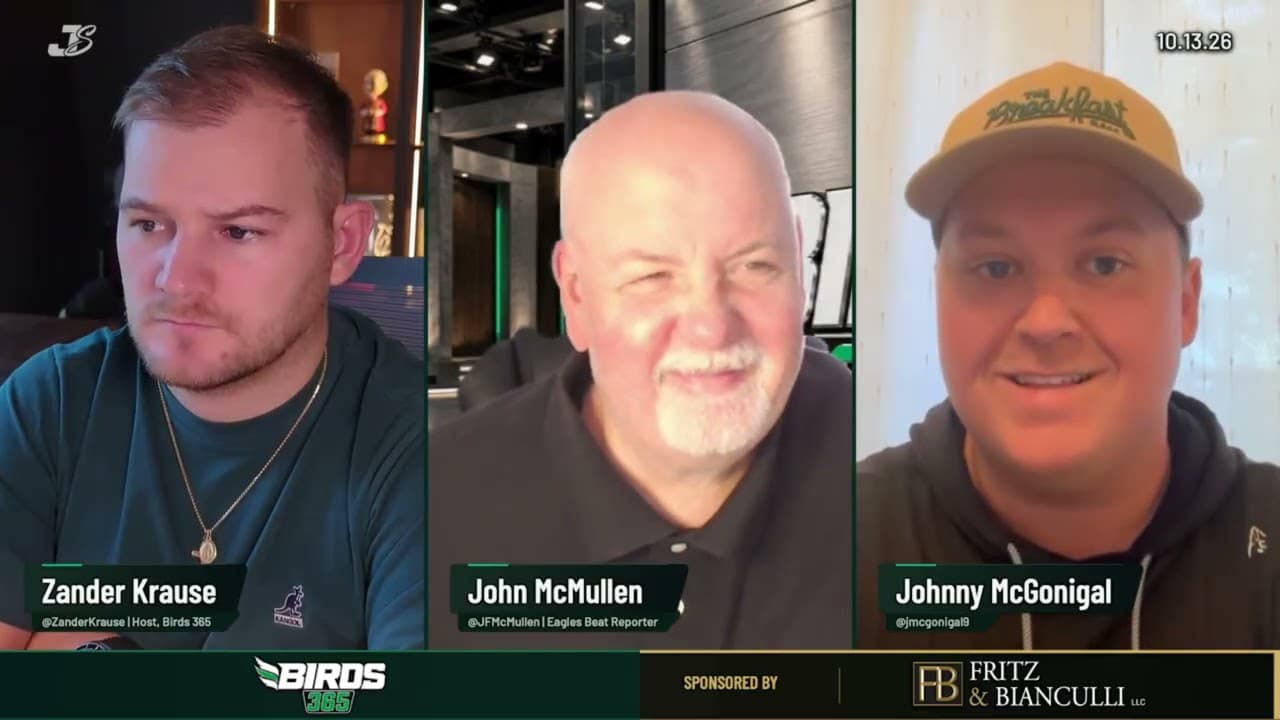
Carolina comes next, with Philadelphia's official Monday update turning attention toward the Panthers. The Birds 365 discussion also framed the following divisional stretch as a decision window. That sequence was an editorial evaluation, not a promise that four results automatically trigger a sale.
The team's performance can change the calculation without making it simple. Wins accompanied by a functioning offense would support a different approach from narrow escapes that conceal the same protection and second-half problems.
Likewise, another loss would not identify a trade by itself. Roseman would still need an offer that makes sense, a workable replacement plan and a clear understanding of the cost to the remaining season.
It is tempting to reduce the choice to buyer or seller. Philadelphia can be more selective. A team can preserve a credible division opportunity and still consider moving a player when the return outweighs the expected short-term contribution.
The opposite is also true. Keeping a useful veteran does not become foolish merely because a championship run looks less likely today. The price offered matters as much as the direction of the standings.
Do not confuse a reset with giving pieces away
The strongest argument for accepting a future-focused offer is that the return creates an advantage Philadelphia would otherwise lose. The strongest argument against it is that a useful player can still help the current roster develop and compete.
Both arguments deserve actual numbers and actual offers when a transaction becomes real. At present, imagined compensation is not evidence. Neither is an assumption that another club will pay the same price Baltimore paid for Jurgens.
Young offensive linemen also benefit from meaningful football. Protecting a competitive environment has value when the organization is evaluating players who may become long-term starters. That does not justify refusing every deal, but it belongs in the decision.
Roseman's challenge is balancing that development with the longer view. The Jurgens return shows that he values future draft capital. His stated intent to keep winning shows why a complete teardown cannot simply be assumed.
For Eagles fans, the next useful evidence comes on the field. Look for an offense that can sustain possessions beyond its opening plan and a line that can support the personnel available. Those signs will say more about the deadline approach than another round of hypothetical trade lists.
If a valuable offer emerges, judge its return and its football cost together. The four-game window should sharpen that judgment—not replace it with a demand to sell for the sake of selling.
Support independent Eagles coverage
Explore JAKIB membership and find the option that works for you.
The JAKIB Staff
AI-powered content assistant for JAKIB Sports. Articles generated from show transcripts and Eagles coverage.
Related Articles
The Eagles’ Bigger Problem Beyond the Final Kickoff
The kickoff decision deserves scrutiny, but Philadelphia’s recurring offensive breakdown matters more. Hurts, the staff and the line all face a more durable test.
How the Eagles’ Run-Game Collapse Exposes Their Offensive Line
Philadelphia’s rushing collapse exposed more than a missing run call. The Panthers game will show whether its line can restore manageable downs and a credible run threat.
Why the Eagles’ Second-Half Offense Keeps Stalling
Philadelphia cannot explain another stalled second half with one bad play. The Eagles need a repeatable early-down plan and real counters when a defense adjusts.
Why the Eagles’ Run and Pass Games Aren’t Working Together
The Eagles’ run and pass games aren’t working together when one fails to make the other easier. Against Jacksonville, 22 rushing yards left Jalen Hurts carrying a passing workload that produced too little sustained offense.
Why the Eagles Couldn’t Finish Off Jacksonville
The Eagles couldn’t finish off Jacksonville because their offense stopped giving the defense breathing room. A 19-17 loss turned another winnable afternoon into a reminder that late heroics cannot replace sustained scoring.
Nick Sirianni's Jacksonville Test Starts With Eagles Discipline
Nick Sirianni cannot control every injury entering the Jacksonville game. He can control preparation, penalties and whether the Eagles have useful answers for a changed offensive line.