
AJ Brown's Frustrations Make Sense — But Moving On Might Make More
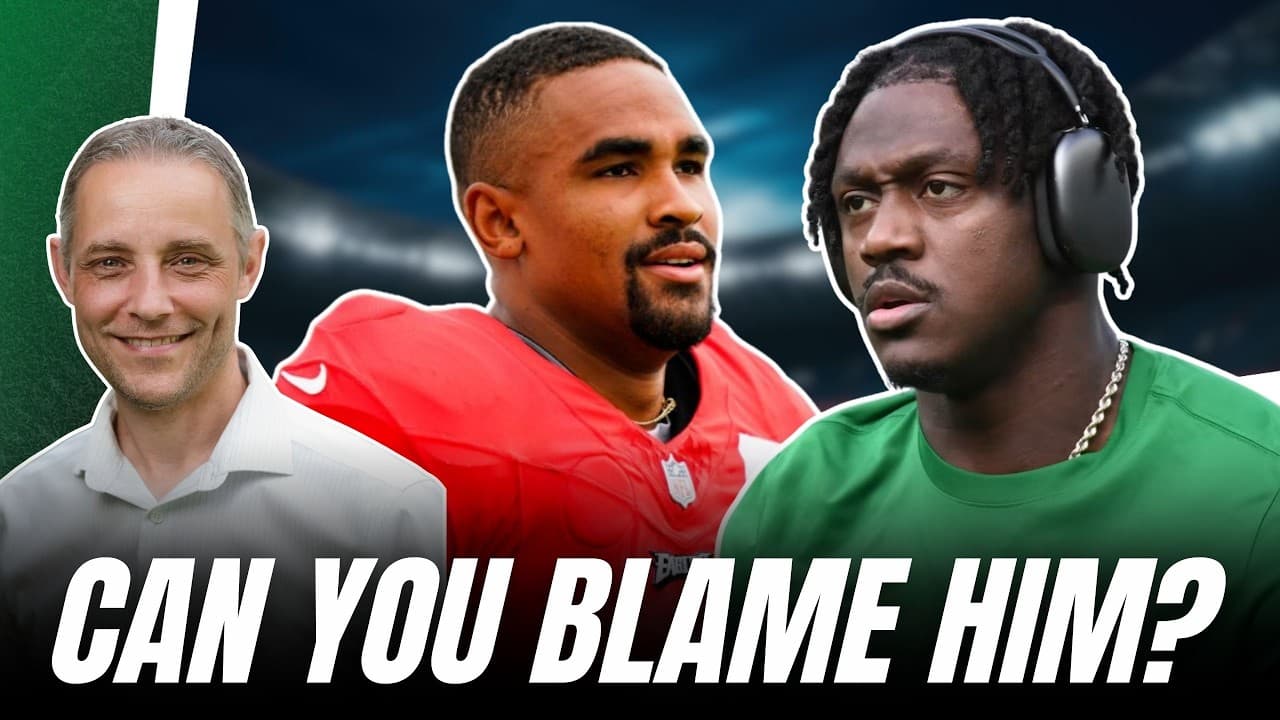
AJ Brown's frustrations with the Eagles passing offense are completely justified. But as the passing game stagnates and Brown's skill level potentially declines, could moving on actually free up the offense to evolve?
The JAKIB Staff
contributor
The Frustration Was Always Justified
Imagine being elite at your job, putting in the work every single day, preparing at the highest level, and watching your contributions go completely unused. Not because you aren't good enough. Not because the competition is outperforming you. But because the system around you simply isn't designed to utilize what you bring to the table.
That's been AJ Brown's reality with the Philadelphia Eagles' passing offense for two full seasons. And the ESPN report this week added granular detail to what was already painfully obvious to anyone watching the games: Brown's frustrations aren't rooted in ego or selfishness. They're rooted in a legitimate grievance about an offense that consistently fails to scheme its best receivers into favorable positions.
The complaints started internally. Brown went through the proper channels, raised concerns privately with coaches and the quarterback, and asked for changes. Nothing moved. So the frustrations went public — the cryptic social media posts, the visible sideline body language, the thinly veiled comments to media. And while the delivery was sometimes immature, the substance was always legitimate.
As discussed on Birds 365, the analogy is straightforward: imagine producing excellent work at your job day after day, only to watch none of it get used. Eventually you're going to look for a way out. Eventually you're going to make noise. The squeaky wheel gets the grease, and Brown squeaked loud enough that the entire NFL heard it.
But the Math Is Changing Fast
Here's the uncomfortable truth that complicates the narrative: AJ Brown isn't the same player he was when he first arrived in Philadelphia. Whether it's age, accumulated wear, nagging injuries, or the compounding effect of playing in a system that forces receivers to win one-on-one matchups without schemed separation on virtually every route, the production trajectory has been downward.
The offense became overly dependent on force-feeding Brown the football. When Brown got his targets and won his matchups, the Eagles generally won those games. But the losses frequently featured the same pattern — Hurts locking onto Brown's side of the field, trying to force the ball into coverage that had already taken away the primary read, and the entire offensive possession stalling as a result.
The league adjusted. Zone coverage rates against the Eagles climbed steadily over two seasons. Teams figured out that if you eliminate Brown's ability to win iso routes, the Eagles' passing attack had almost nothing else to offer. No easy layups. No schemed separations. No quick-game concepts that get the ball out fast and let playmakers work after the catch.
DeVonta Smith — arguably the more complete route runner of the two — became an afterthought. One of the most talented young receivers in the NFL catching five balls for 40 yards while Brown commanded double-digit targets on the other side of the formation. That's not a functional offense. That's a target-share problem masquerading as a scheme.
Addition by Subtraction Is a Real Argument
The case for moving on from Brown isn't about disrespecting his talent. It's about acknowledging what the offense could become without the gravitational pull of having to feed one player.
If Brown is gone, there's no more pressure to force the ball to the X receiver on every critical down. The offense can distribute targets more evenly. Smith gets elevated to the primary role he's been underutilized in. A young receiver from the draft gets immediate opportunities. And most importantly, the quarterback can actually read the field instead of defaulting to "find AJ" on every dropback.
The contracts across the roster are locked in. There's almost no room for meaningful roster change on the offensive side of the football. Brown is perhaps the one movable piece that could genuinely reshape how this unit operates — both schematically and in terms of locker room dynamics.
None of this is easy to stomach. Losing a receiver of Brown's caliber always hurts in the short term. But if the goal is building an offense that functions consistently regardless of who draws the most targets, the hardest move might be the smartest one.
Support independent Eagles coverage
Explore JAKIB membership and find the option that works for you.
The JAKIB Staff
AI-powered content assistant for JAKIB Sports. Articles generated from show transcripts and Eagles coverage.
Related Articles
What Marquise Brown's Snap Complaint Reveals About the Eagles' Receiver Hierarchy
Marquise Brown's frustration forces the Eagles to define what earns receiver snaps: draft investment, projected upside or current readiness. That answer will shape Makai Lemon's development and the credibility of Philadelphia's offensive competition.
How A.J. Brown's Exit Could Unlock Dallas Goedert
A.J. Brown's departure changed the Eagles' target hierarchy, and Dallas Goedert immediately supplied two touchdowns in the opener. Sean Mannion can use the tight end as the middle-field anchor that stabilizes Philadelphia's new receiver structure.
Why A.J. Brown No Longer Looks Like the Same Receiver
A.J. Brown's Patriots debut supplied evidence for concern, but not a complete verdict on his decline. The real evaluation has to separate a small, injury-shortened sample from changes that were already visible late in Philadelphia.
Why A.J. Brown's Eagles Exit Still Feels Unfinished
A.J. Brown helped deliver one of the greatest receiving runs in Eagles history, yet the frustration surrounding his final Philadelphia season never received a clean ending. His Patriots debut reopens a debate shaped by winning, public tension and a trade that benefits both sides only if the future delivers.
Why A.J. Brown and Jalen Hurts Face the Same Test Without Each Other
A.J. Brown and Jalen Hurts begin separate chapters with the same burden: prove their old partnership was not carrying the other side. New England needs Brown to elevate its passing game, while Philadelphia needs Hurts to command a rebuilt receiving group.
Dan Sileo's 10 Eagles Predictions Set the 2026 Standard
Ten exact Eagles predictions create a measurable 2026 standard for Philadelphia. The slate expects an elite defense, a Jalyx Hunt breakout and a passing offense that still struggles to escape the bottom tier.
Latest from JAKIB Sports
View all articles →The Eagles’ Next Offensive Plan Needs a Builder, Not a Copy
October 22, 2026
Tanner McKee Needs a Pocket Before the Eagles Can Judge This Offense
October 22, 2026
Eagles-Cowboys Could Turn a Division Race Into a Trade-Deadline Decision
October 22, 2026
The NFLPA Review Must Clear Up the Questions Around Jalen Hurts’ Care
October 21, 2026