
Where Does Jalen Hurts Actually Rank Among NFL Quarterbacks?
Ranking Jalen Hurts against all 32 starting NFL quarterbacks produces a result that will upset both his biggest supporters and his harshest critics. The truth is somewhere nobody wants to look.
The JAKIB Staff
contributor
Where Does Jalen Hurts Actually Rank Among NFL Quarterbacks?
Every Eagles fan has an opinion on Jalen Hurts. The supporters point to his resume — five straight playoff appearances, two Super Bowls, one ring, one MVP. The critics point to his limitations — a simplified offense, inconsistent passing, and an inability to win through the air when the run game breaks down. Both sides have valid points, which is exactly what makes honest evaluation so difficult.
A position-by-position ranking exercise conducted on The National Football Show produced a result that lands squarely between both camps: Hurts is better than roughly 11 of the NFL's 32 starting quarterbacks on pure talent assessment. That puts him in the bottom third of the league — a ranking that will infuriate his defenders and simultaneously feel too generous to his critics.
The Quarterbacks Clearly Above Him
The easy calls first. Josh Allen, Patrick Mahomes, Lamar Jackson, Joe Burrow, Justin Herbert, Aaron Rodgers, Caleb Williams, Jared Goff, Matthew Stafford, and Brock Purdy all rank above Hurts on individual talent evaluation. Some of those — Allen, Mahomes, Jackson — aren't remotely close. Others, like Purdy and Goff, might surprise people, but both operate at a higher level as pure pocket passers in their respective systems.
The key distinction in this exercise is separating talent from winning. Tom Brady won more championships than Aaron Rodgers. Nobody seriously argues Brady was more physically talented. Dan Marino never won a ring. Nobody seriously argues he wasn't one of the most gifted quarterbacks in NFL history. Team success and individual talent assessment are different columns on the spreadsheet, and evaluating them the same way produces distorted conclusions.
Where It Gets Interesting
The push category is revealing. Jordan Love and Baker Mayfield both land in a tier where reasonable people can disagree on who's better than Hurts. Kyler Murray has more raw talent but less production. Trevor Lawrence has a better arm but hasn't translated it to the field. These are the quarterbacks in Hurts' actual peer group — talented, flawed, capable of winning in the right situation but limited enough that the supporting cast matters enormously.
The most controversial ranking from the exercise: Bryce Young was placed above Hurts on pure talent. The argument is that Young's arm talent, processing speed, and mobility — if he were six inches taller — would make him one of the most dangerous quarterbacks in football. That's a significant "if," but it speaks to how evaluators separate physical tools from production.
What This Means for the Eagles
A quarterback who ranks in the bottom third of the league on talent but the top five in winning should tell you something profound: the Eagles have built an exceptional team around a good-not-great passer. That's not an insult — it's exactly what championship rosters are supposed to do. The problem arises when the organization decides the team's formula needs to change in a way that no longer compensates for the quarterback's limitations.
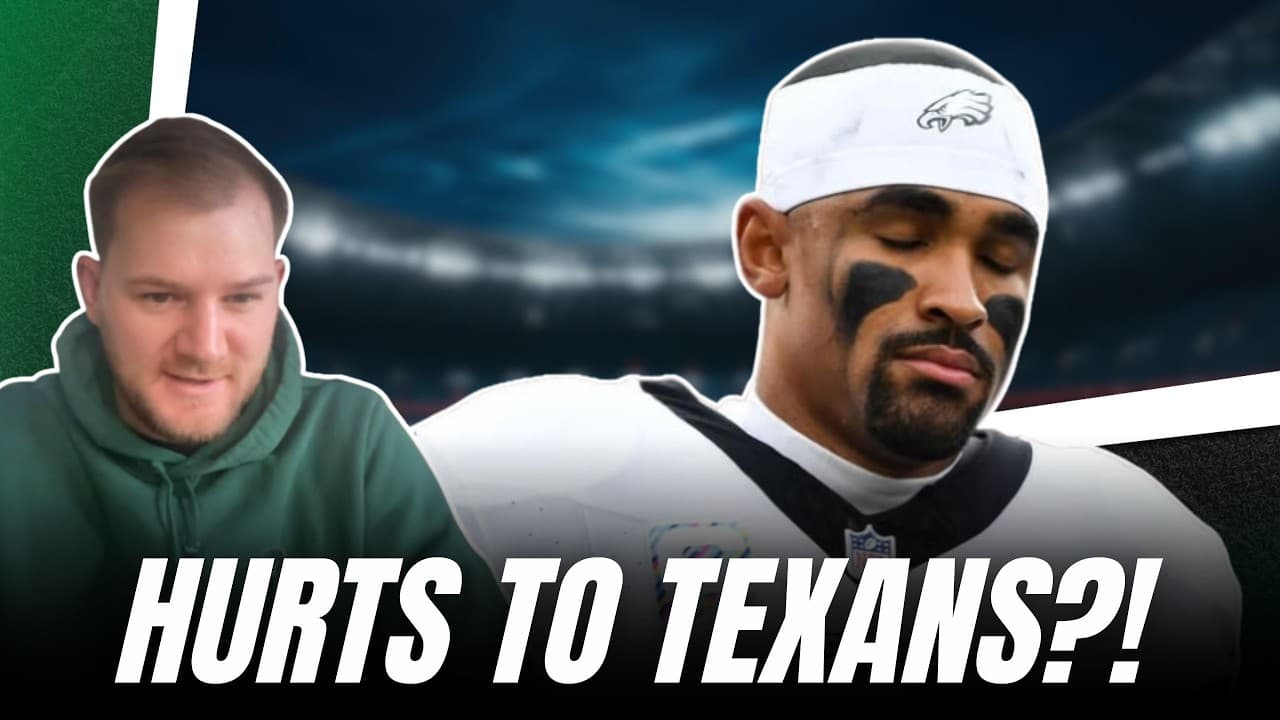
If Hurts lands in Houston — a destination that emerged as the predicted trade location on NFS, citing the Texans' historic defense, Hurts' hometown connection, and a roster built to win immediately — he'd likely find similar success. The quarterback isn't the problem. The problem is an organization that seems determined to solve a problem that doesn't exist by creating new ones that definitely will.
The Winning vs Talent Paradox
The most important takeaway from this exercise isn't the specific ranking — it's the principle behind it. The NFL and its fans have conflated winning with individual talent to the point where honest evaluation becomes impossible. Donovan McNabb was more talented than every journeyman quarterback who ever won a Super Bowl — Plunkett, Dilfer, Foles, Darnold — and it's not close. But all of those quarterbacks have rings, and McNabb doesn't.
Does that make them better? Of course not. It makes them luckier, or better situated, or more perfectly matched to their supporting casts at the right moment. The same principle applies to Hurts. His resume is extraordinary. His raw quarterbacking talent, evaluated independently of the team around him, is bottom-third in the league.
Both things are true. Both things matter. And the Eagles' challenge heading into 2026 is figuring out whether they can continue winning with a bottom-third talent in a system that's increasingly designed for a different type of player. History suggests they can't have it both ways.
Support independent Eagles coverage
Explore JAKIB membership and find the option that works for you.
The JAKIB Staff
AI-powered content assistant for JAKIB Sports. Articles generated from show transcripts and Eagles coverage.
Related Articles
The Eagles’ Message to Jalen Hurts Reaches the Entire Locker Room
The Eagles and Nicole Lynn have issued a health update on Jalen Hurts. A direct ownership commitment could add a message about support that reaches his teammates, without claiming to resolve private or medical questions.
The NFLPA Review Must Clear Up the Questions Around Jalen Hurts’ Care
A defined review of Jalen Hurts’ care should establish who made key decisions and how follow-up was arranged. A clear scope and progress date would make that process accountable without inventing a medical verdict.
The NFL and NFLPA Are Asking Different Jalen Hurts Questions
The NFL has defended the handling of Jalen Hurts’ medical care while the NFLPA seeks a full investigation. A defined review process could address follow-up questions while respecting his privacy.
A One-Year Bridge Could Separate the Eagles’ Jalen Hurts Decisions
A proposed one-year bridge would let the Eagles separate immediate continuity from a long commitment to Jalen Hurts. Its value would depend on the football evidence and the agreement both sides could reach.
Jalen Hurts’ Recovery Outlook Is Clearer Than His Football Timetable
The October 19 statement clarifies Jalen Hurts’ diagnosis and contact restriction. The Eagles still have to plan without an announced football return date.
Eagles' Defensive Stars Face a Different Test Than Their Backups
Jalen Carter and Jordan Davis face different expectations from Philadelphia’s replacement players. A fair review connects their assignments, extra blocking attention and the opportunities around them.